

As an administrator, you can define, view, edit, attach or detach an SLA with service models. A service-level agreement (SLA) is a contract that specifies the service expectations of internal or external customers. An example is the downtime that is acceptable for various resources. You can monitor service performance based on specified thresholds and receive a notification when the SLA approaches or breaches the thresholds.
SLAs let you track service metrics over a specified interval based on specific thresholds. They can help ensure adherence to any quality or availability requirements that an organization must maintain.
SLAs in CA SOI are based on the following attributes:
Each SLA is based on one of the core CA SOI metrics. An SLA calculates violations that are based on a threshold, spans a defined time period, and is optionally only monitored during defined business hours.
CA SOI uses the measurable provisions that you specify in the SLA to monitor the real-time health of each associated service, and records outage time when the service is down. The recorded time is compared to the SLA thresholds to determine the status of the SLA for a given time period.
For example, you can define an SLA that tracks the quality of a customer-facing website. If the quality drops below the threshold level, an outage is recorded. If the quality stays below the threshold level past the defined threshold time, a violation is recorded. You can track the SLA status through the Operations Console, Dashboard, and reports to ensure that the website meets the customer quality expectation level.
For an in-depth example, see SLA Example.
When you create an SLA for a service, the SLA evaluation begins after the SLA period start date and when the defined business hours begin, if applicable. The SLA tracks outages and violations; an outage occurs when the service crosses the threshold defined in the SLA. A violation occurs when the service crosses the threshold for the amount of time defined in the SLA.
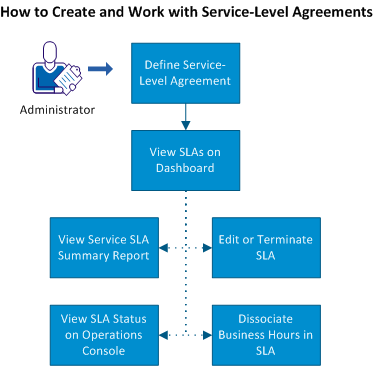
Use this scenario to guide you through the process:
|
Copyright © 2013 CA.
All rights reserved.
|
|