

Implementation in a Microsoft Cluster Server Environment › How to Implement CA SOI in an MSCS Environment
How to Implement CA SOI in an MSCS Environment
As an administrator, you can implement high availability in an MSCS environment.
High availability, which is also known as fault tolerance or failover, is a common architectural requirement. High availability is based on a Microsoft Cluster Server (MSCS). High availability helps to ensure a business continuity during an IT resource interruption. The main objective of implementing a high availability solution is no downtime for IT resources. High availability support for CA SOI provides failover capabilities and a solution for applying maintenance while avoiding product downtime.
Use this scenario to guide you through the process:
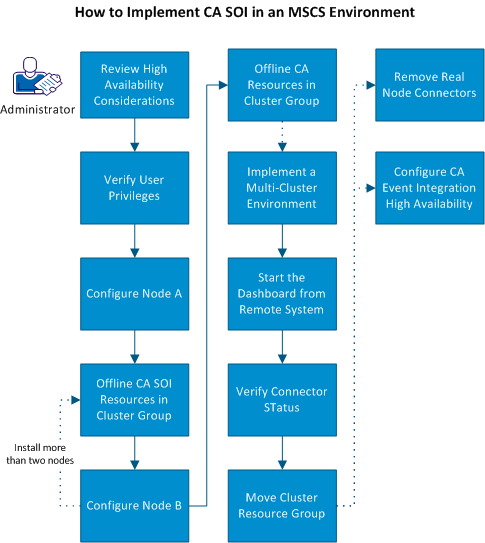
- Review the high availability implementation considerations.
- Verify user privileges.
- Configure Node A.
- Offline all CA SOI resources in the cluster group.
- Configure Node B.
- (Optional) Repeat steps 4-5 to install on more than two nodes in the cluster, if necessary.
- Offline all CA SOI resources in the cluster group.
- If you installed the necessary CA SOI components on the cluster nodes, skip to Step 10. For a multi-cluster deployment, continue with Step 9.
- (Optional) Implement a multi-cluster deployment.
- Start the Dashboard from a remote system.
- Verify the status of all connectors.
- Move the cluster resource group in each cluster to the node that you want to remain active.
- (Optional) Remove any real node connectors from the Administration tabif the appropriate virtual node connectors exist.
- (CA Event Integration Only) Configure CA Event Integration high availability.
Copyright © 2013 CA.
All rights reserved.
|
|