

How CA PMO Optimizes Directory Searches › Searches Initiated by Program Management › How CA PMO Optimizes Program Management Searches › Sequence of Program Management Searches with CA PMO
Sequence of Program Management Searches with CA PMO
When you use CA PMO, the Program Management search sequence is simplified. The specific sequence that Program Management uses is described in the following list:
- Program Management starts the search for a module in the Job Pack Area (JPA). If it finds the module, the search ends successfully; otherwise, Program Management initiates a directory search of the JOB/STEP/TASK libraries.
- If Program Management continued the search, the request could be resolved by LLA (that is, if LLA is managing the libraries in the concatenation). However, at this point, CA PMO gains control and searches the hash tables for the member.
- If the member has an entry in one of the hash tables, the search ends successfully. DASD I/O is avoided because the member is found using an in-storage search.
- If CA PMO does not find the entry for the member in the hash tables, it returns control to Program Management.
- Program Management searches for the module in the LPA. If the module is in LPA, the search is resolved successfully. Otherwise, Program Management initiates a directory search against the LNKLST concatenation of libraries.
- At this point, CA PMO gains control and searches the managed list for an entry for the member.
- If the member has an entry in the managed list, and it is marked as having been found during a previous LNKLST search, CA PMO resolves the search successfully. DASD I/O is avoided because CA PMO uses an in-storage search to locate the member.
- If the member has a managed list entry, and the entry is marked as not found during a previous LNKLST search, CA PMO resolves the search unsuccessfully and an S806 abend follows. DASD I/O is avoided because CA PMO uses an in-storage search to determine that the member cannot be found.
- If the member is not found, CA PMO returns control to the system's directory search function.
- The z/OS search function searches for the member in the LLA or the LNKLST libraries. This search may require DASD I/O.
- If the member has a directory entry in any of these locations, the search ends successfully. CA PMO adds the directory entry of the member and the index of its owning LNKLST library to the managed list. CA PMO marks the new entry as a "found" member. This avoids future I/O directory searches for the member because CA PMOcan now determine the directory entry for the member from the managed list.
- If the directory entry for the member is not found, the search ends unsuccessfully and an S806 abend follows. CA PMO adds the directory entry to the managed list, marking the entry as a "not found" member. This avoids future I/O directory searches for the member because CA PMO can now determine from the managed list that the member will not be found.
The following illustration shows the Program Management search sequence when optimized by CA PMO. Notice that steps 2 and 4 in this figure represent in-storage searches. These steps replace the DASD I/O searches shown in steps 2 and 4 of the illustration titled Program Management Standard Order of Search.
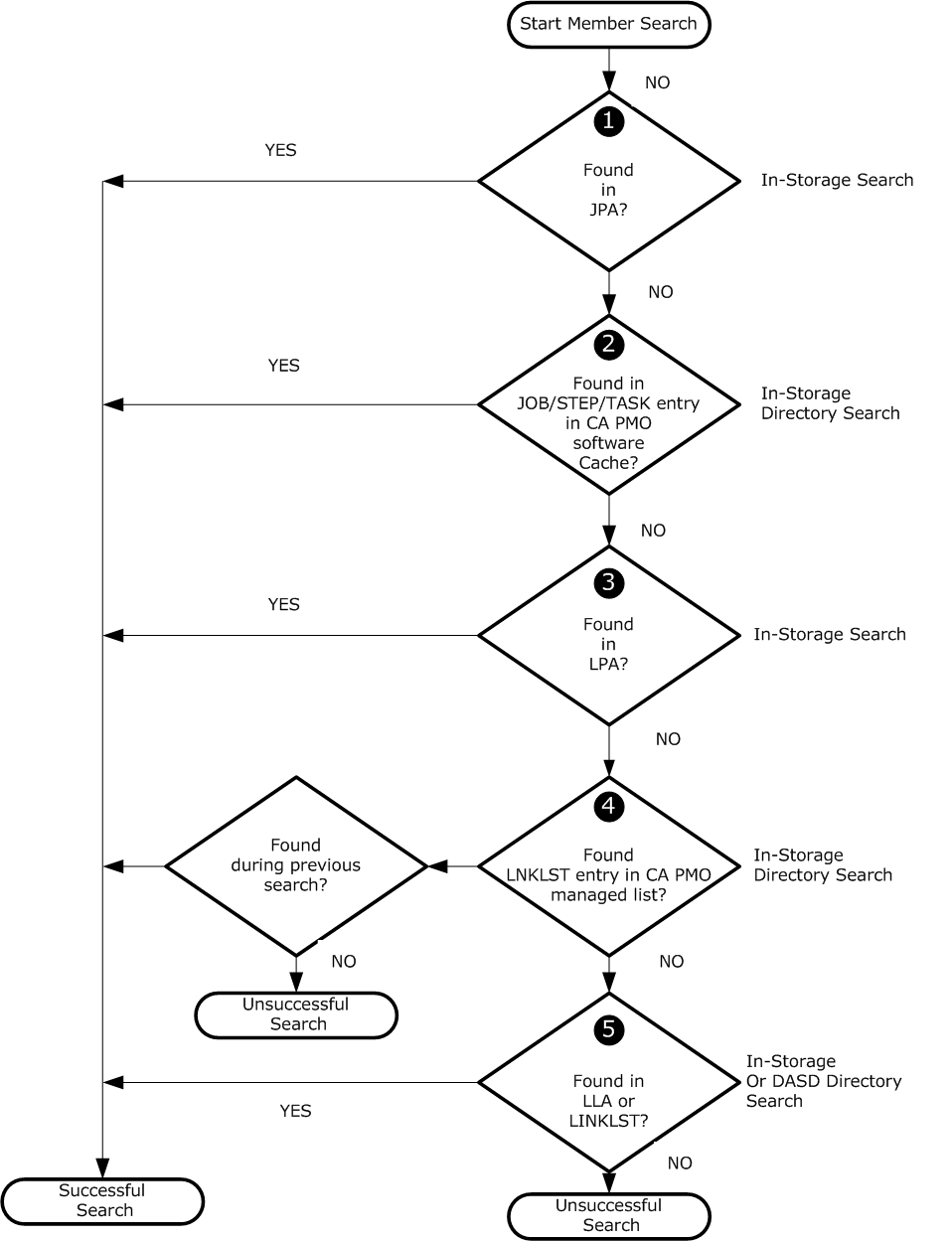
CA PMO Optimized Program Management Searches
Copyright © 2011 CA.
All rights reserved.
|
|