This section contains the following topics:
SMFAJT - SMF Daily Top 10 APPC Transaction Jobs
SMFBJT - SMF Daily Top 10 Batch Jobs
SMFBPT - SMF Daily Top 10 Batch Programs
SMFSAT - SMF Daily Top 10 System Address Spaces
SMFSJT - SMF Daily Top 10 Started Task Jobs
SMFTUT - SMF Daily Top 10 TSO Users
SMFUJT - SMF Daily Top 10 Unix SysSrv Jobs
The SMFAJT query generates several chart sets. These chart sets show the daily top nn (default 10) APPC Transaction Programs (TPs) using CPU, I/O, and central storage (memory) resources on your z/OS systems. For each resource type, one chart set shows the top ten APPC TPs using the resource over the entire Central Processing Complex (CPC), and another that shows the top ten APPC TPs for each z/OS system. The query reads detail data from the BAT_TP (APPC/MVS TP Activity) file, and summarizes the data by job name executed. The charted data reflects summarized interval and step record information from all job steps for the top ten APPC TPs.
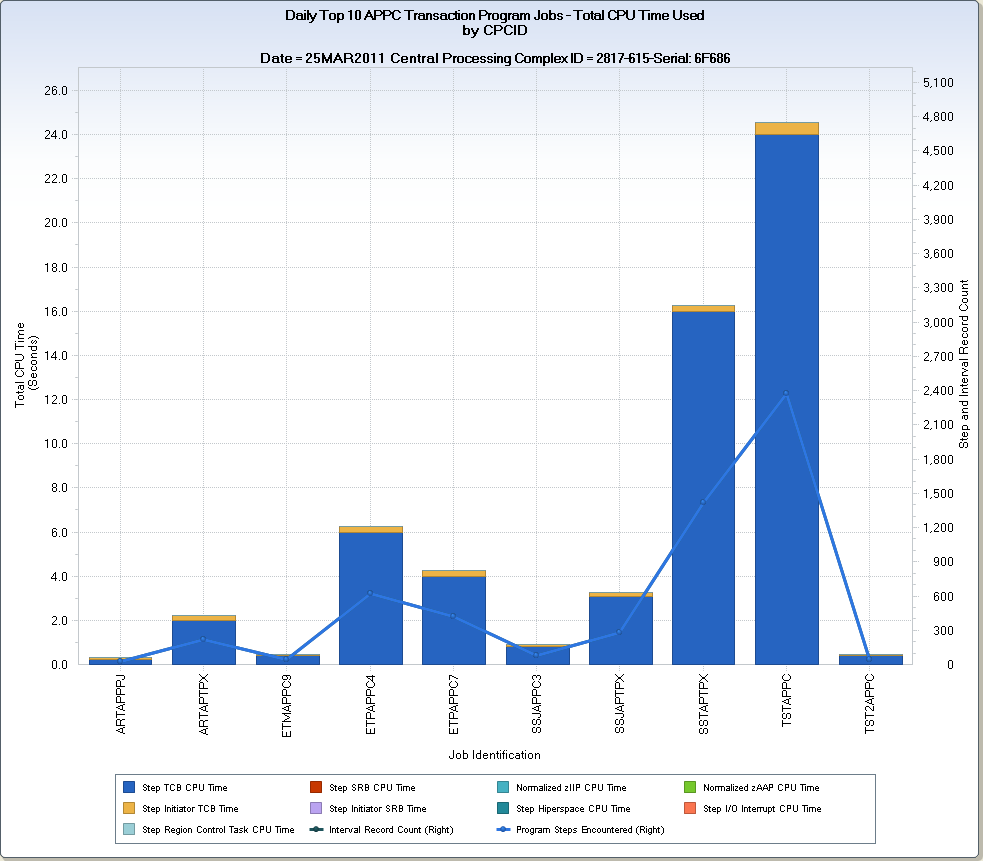
For CPU, the CPU time used by each of the top ten APPC TPs is displayed using a vertical bar. The bar is segmented by CPU time type (for example, TCB, SRB, I/O Interrupt, zIIP, zAAP, and so on). Two horizontal lines show the program count (number of unique program executions) and interval count (number of interval records) encountered for the APPC TP. For short running steps, the interval count and program count values have similar values. For long running programs, the interval count exceeds the program count.
Note: The program count data element (PGMCOUNT) is only set to one (1) for the last interval record for a long running program. For APPC TPs with a long running program step that has not yet ended, PGMCOUNT is zero.
For I/O, I/O Service Units are used to determine the top ten APPC TPs. Three different chart views are available to display I/O related resource utilization. The first view shows I/O service units for the top ten using vertical bars. The second view displays device connect time for the top ten by device class (for example, DASD, TAPE, Unit Record, and so on). The device connect time is displayed using a vertical bar, with the bar segmented by the time connected to each of the device classes. The final view shows EXCPs by device class, again using a segmented vertical bar. As with the CPU chart, the program and interval record count are shown using a horizontal line.
For central storage, the top ten APPC TPs with the largest average working set size are displayed. Average working set size is the average number page frames in central storage used by the program. The page frame count is shown using a vertical bar and the program and interval record count are shown using a horizontal line.
Note: The average working set size represents the average for all step and interval records encountered for each top ten APPC TP.
The example shows the CPC level chart generated for APPC TSs executing on an IBM z/196 2817-615 CPC. The largest user of CPU time was the APPC TP ‘TSTAPPC’. The chart shows that for the day depicted, the job had 2374 program step executions, recorded with 2374 interval records, and consumed just over 24 seconds of CPU time. Most of this time was Step TCB Time.
It is important to understand which applications are the biggest consumers of limited and expensive IT resources. This query shows the largest APPC TP consumers running on z/OS systems—at both the CPC and individual z/OS system level. Knowing not only the amount of resource consumed, but also the frequency of program execution, can help you to focus tuning efforts where potential payback is greatest. Tracking utilization by job name may or may not be useful at your installation—and is largely dependent on job naming standards.
Note: The following SMFAJT query data extracts display the same X- and Y-axis data elements as those elements displayed by the SMFBJT query. The only difference is that this SMFAJT query shows the top nn APPC TP jobs, while the SMFBJT query output shows the top nn batch jobs. For the data extract chart samples and axis values, see the SMFBJT query description.
SMF Daily Top 10 APPC Jobs CPU CPCID
SMF Daily Top 10 APPC Jobs CPU SYSID
SMF Daily Top 10 APPC Jobs IO CPCID
VIEW 1 – SMF Daily Top 10 APPC Jobs I/O – Service Units CPCID
VIEW 2 – SMF Daily Top 10 APPC Jobs I/O – Connect Time CPCID
VIEW 3 – SMF Daily Top 10 APPC Jobs I/O – EXCPs CPCID
SMF Daily Top 10 APPC Jobs IO SYSID
VIEW 1 – SMF Daily Top 10 APPC Jobs I/O – Service Units SYSID
VIEW 2 – SMF Daily Top 10 APPC Jobs I/O – Connect Time SYSID
VIEW 3 – SMF Daily Top 10 APPC Jobs I/O – EXCPs SYSID
SMF Daily Top 10 APPC Jobs Memory CPCID
SMF Daily Top 10 APPC Jobs Memory SYSID
DATEPART(ENDTS)
TRIM(LPCMOD)||'-'||TRIM(CPCMODID)||'-Serial: '||SUBSTR(CPCSEQNB,12,5);
SUM(PGMTCBTM,PGMSRBTM,PGMHIPTM,PGMRCTTM,PGMIOITM,
PGMSPNTM,PGMZPNTM,PGMISRTM,PGMITCTM) ;
INTVLCNT=1 ;
(uses existing data element PGMCOACT=1 in the initial input user code, then after summarization sets INTVLCNT=PGMCOACT to deal with Q&R default of treating Q&R derived elements as retained values in summarization).
The following modifications can be made to the SMFAJT query:
Note: This query charts two nonessential data elements: PGMITCTM and PGMISRTM (Initiator TCB and SRB time, respectively). If these data elements are not active in your step level files, the query fails to execute. To run the query, you can remove these two data elements from the ELEMENT SELECTION task in the two CPU time Data Extract steps. You can also ask your CA MICS administrator to activate these two elements in the step level files by changing the element definition in sharedprefix.MICS.GENLIB(SMFGENIN) from NAMX to NAME and then running the sharedprefix.MICS.CNTL(SMFCGEN) job. After these elements are activated, refresh the Q&R Meta Database.
| Copyright © 2011 CA. All rights reserved. | Email CA Technologies about this topic |