

The life cycle events of data definition management mirror those of the software development life cycle. The functional areas within CA IDMS software management include change identification, change management and release management.
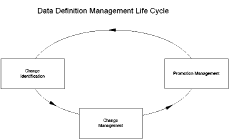
Change Identification – Dictionary updates are captured and logged during the process of change identification, providing an audit trail which accurately reflects what entities were changed by whom, when, and why. With this information, it is possible to focus testing efforts on those areas of systems which have changed and to further determine accountability for all changes. These statistics not only provide vital audit information, but also serve as the basis for all change management and release management activities.
Change Management – Activities revolve around tracking, reporting and analyzing dictionary updates. To effectively perform these activities, managers need online access to a database which automatically stores and maintains the relationships between users, entities and updates. They also require the ability to categorize and track that change information in ways that directly relate to their organization's business structure.
Promotion Management – Encompasses the promotion and distribution of software throughout the development life cycle and beyond. The complex nature of the CA IDMS environment — multiple dictionaries in multiple central versions on multiple machines— poses a number of serious problems when managing software releases, whether those software systems are built or bought. Accurately identifying a complete promotion package is only part of the bigger management challenge of handling multiple releases, determining potential impact on the target system, and incorporating internal customizations with vendor updates.
|
Copyright © 2013 CA.
All rights reserved.
|
|