

While the software development life cycle varies from installation to installation within the CA IDMS environment, the basic ingredients are the same, as are the major concerns.
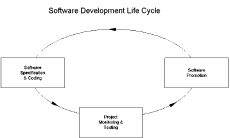
Software Specification and Coding – In the CA IDMS environment, programmers design and code applications interactively using 4th generation tools. CA IDMS provides a built-in data dictionary structure within which component interrelationships (applications, dialogs, maps, records, etc.) are classified and stored. Problems arise when updates made to one part of the dictionary are not properly propagated to other affected components. For example, changes made to a map used by one dialog can prevent execution of another dialog which shares that map if the changes are not synchronized. These problems multiply quickly in the real-time CA IDMS environment. Programmers and managers seek accurate methods of identifying and keeping track of changing dictionary interrelationships — while maintaining the benefits of a dynamic programming environment.
Project Monitoring and Testing – During this stage of development, project leaders and managers monitor programming activity, and perform testing and change impact analysis. Project monitoring requires the ability to obtain project status and to classify changes relating to specific project teams. Testing requires the ability to pinpoint exactly what has changed so that the impact of those changes can be accurately determined. These capabilities are not readily provided in the native CA IDMS environment.
Promotion – When moving information from one dictionary to another within CA IDMS, it is difficult to determine what a promotion package should consist of— its dialogs, records, maps and so forth. And since the interrelationships of all those components are architecturally complex, so too is the promotion process. To solve the problems inherent in CA IDMS promotions, installations often resort to copying and promoting entire applications and/or dictionaries, a procedure which quickly becomes impractical and resource-intensive. The ideal solution ensures a complete promotion — not too much or too little.
|
Copyright © 2013 CA.
All rights reserved.
|
|