

A node can control one or more databases. Each node maintains a table (the resource name table) that lists the database(s) it has access to, their locations, and how to reach them. This table is maintained by CA IDMS DDS at the node, allowing the location of any database to be transparent to applications.
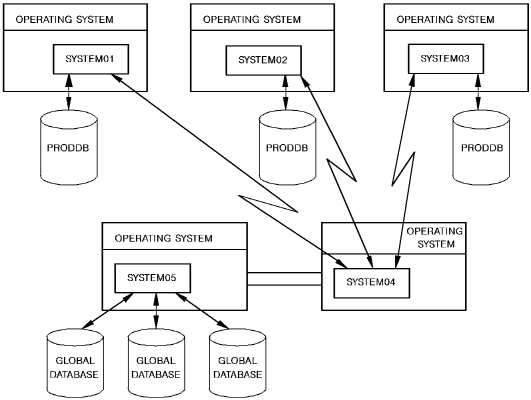
Database names can be duplicated within the network. Each node can control a database that replicates local databases controlled by other nodes in the network. Each node's table would simply define the location of the database as local, and applications asking for that database would access the local one.
The choice between local and global databases should be based on how the databases are accessed. For example, if each site in a network maintains its own production database, those databases could each have the same name and be defined as local databases. However, if the organization maintains a central database required by multiple sites, it would make sense to define that database as global.
The following illustration shows a CA IDMS DDS network configuration that maintains local production databases at distributed sites while also maintaining centrally located global databases.
|
Copyright © 2013 CA.
All rights reserved.
|
|