

|
|
|
The following diagram shows the various components involved in generating a CA Service Desk ticket from a given instance of a z/OS system event involving a recognized CA product. The explanation follows the flow from left to right on the diagram.
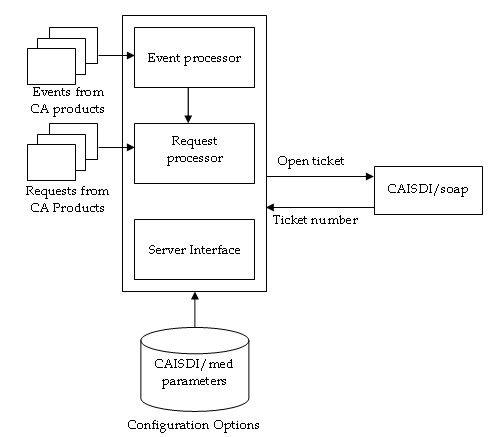
The CAISDI/med facility executes as an address space on a z/OS operating system. Through customizable parameters, CAISDI/med is able to monitor the z/OS system for selected events, both solicited and unsolicited, that are generated by other z/OS-based CA products. Events such as product abends from CA products defined to CAISDI/med are captured and used to automatically open a CA Service Desk ticket on the defined CA Service Desk server. Events recognized by CAISDI/med that warrant a CA Service Desk ticket are presented directly to CAISDI/med by the defined z/OS-based CA product through an internal call mechanism.
CAISDI/med relies on two components to provide a connection between the z/OS operating system and the CA Service Desk server:
Both of these components are provided on the CA Common Services for z/OS product tape. TCP/IP is used to communicate between the CAISDI/soap component and the CA Service Desk server; therefore, TCP/IP is considered a prerequisite as well.
As previously mentioned, CAISDI/med provides a means to determine which z/OS-based CA product events are to be captured. Similarly, CA Service Desk tickets generated by CAISDI/med can be directed to one or many CA Service Desk servers. CA Service Desk tickets can be customized to assign appropriate attributes to a given ticket so that it can be categorized, assigned, and prioritized as needed to ensure effective event tracking and awareness.
Once the CAISDI/med address space is initialized, it establishes a means of examining selected z/OS system events that occur for recognized CA products. These system events are captured in an encapsulated fashion and presented to the event manager task in the CAISDI/med address space. Using configuration options supplied through CAISDI/med initialization statements, the event manager task formats a request for a CA Service Desk ticket, and passes the request to the request manager task within the CAISDI/med address space.
In addition to asynchronous system events, CAISDI/med provides a means for CA products to directly communicate requests that pertain to events of interest to individual CA products. Again, using configuration options, the request manager constructs a request for a CA Service Desk ticket and passes the request to the appropriate server interface task within the CAISDI/med address space.
A given instance of a CAISDI/med service interface task is attached for each unique instance of a CA Service Desk server that is defined to CAISDI/med through the configuration options. In other words, there is a CAISDI/med server task for each unique CA Service Desk URL address that is supplied by way of CAISDI/med initialization statements. A ticket is formulated and then passed to the CAISDI/soap address space.
| Copyright © 2012 CA. All rights reserved. | Tell Technical Publications how we can improve this information |