

The CA Business Service Insight data model has been designed to meet and overcome the following challenge.
Raw data is retrieved by the Adapters from various, disparate data sources and held in a variety of formats. This diverse data needs to be retrieved and homogenized into a single database table. Therefore, the Adapters are required to read and normalize the data into a unified data model, as shown in the following figure.
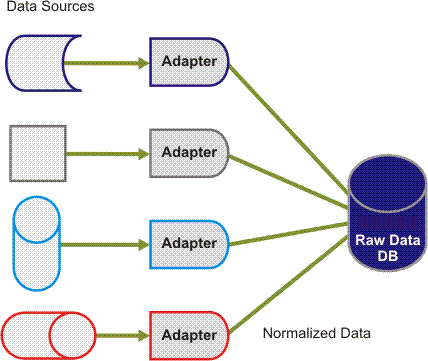
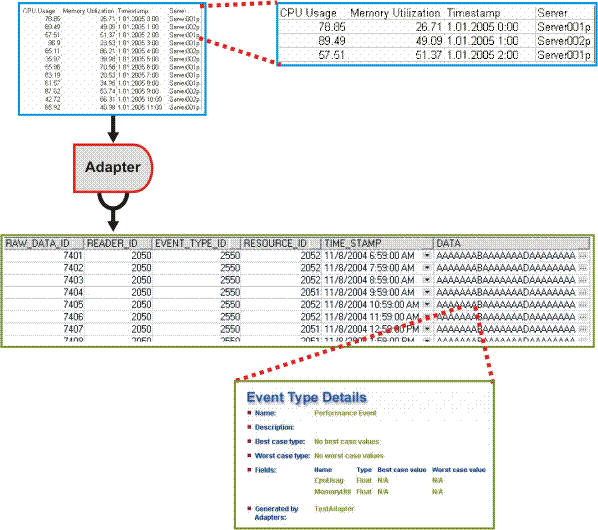
As part of this process, all data fields are inserted into the same database table field, but they are encrypted. Each line inserted into the CA Business Service Insight database has an Event Type identifier attached to it. The Event Type definition contains descriptions of the data fields. It also enables the Correlation engine to correctly interpret the data fields and identify when they are required by the Business Logic for calculations.
The following figure shows a graphical representation of the data retrieval and database population section of this process. Also depicted is an enlarged section showing what the data represents in real-life terms, rather than how the raw data appears.
The CA Business Service Insight system also includes all Contracts and Metrics that require evaluation against the raw data to produce resulting service level performance information. Each Metric must receive only the subset of data relevant to its calculation. The raw data holds a potentially vast number of records of various types. Using the Metric to filter the relevant Events by their values is very inefficient. Therefore, the CA Business Service Insight engine distributes the relevant raw data to each specific Metric.
Example:
For the following two Metrics in a Contract:
The first Metric is required to evaluate only those tickets with Priority 1, and the second Metric, only Priority 2 tickets. Therefore, the engine needs to distribute the records accordingly. In addition, the resolution time within one Contract is calculated for P1 tickets that are opened for contract party A, while in the second Contract, P1 tickets for contract party B, and in the third P2 tickets for contract party C. Therefore, the engine is required to select the ticket type and customer for whom it was reported, as shown in the following figure.
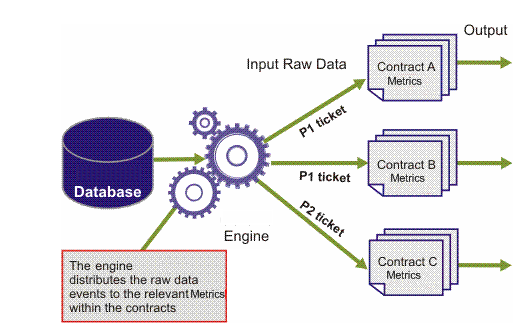
As previously explained, the raw data records have attached identifiers that allow the engine to identify the records and Events relevant to each Metric's Business Logic. The two identifiers are the Event type and the Resource.
|
Copyright © 2013 CA.
All rights reserved.
|
|