

In the North American Eastern Standard Time Zone, DST starts on the second Sunday of March at 2:00 a.m.; the time springs forward one hour to 3:00 a.m. The following illustration displays DST spring forward:
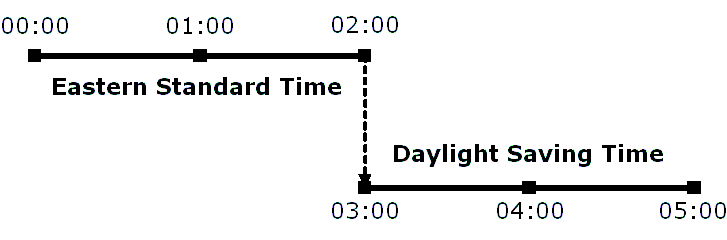
Events that are scheduled to run during the spring-forward transition period (2:00 a.m. to 3:00 a.m. on the day spring forward occurs) run immediately after the transition at 3:00 a.m. For example, Event A is scheduled at 2:30 a.m. on March 11, 2007. At 01:59:59 a.m., the time springs forward to 3:00 a.m. At 3:00 a.m., the server considers Event A overdue and triggers the Event immediately.
At the job level, if a job has a submission time of 2:30 a.m., the server submits the job at 3:00 a.m. (assuming all other dependencies have been met). For example, Event B is scheduled daily, suspended at 2:30 a.m., and resumed at 5:00 a.m. On March 11, 2007, the server suspends the Event at 3:00 a.m. and resumes the Event at 5:00 a.m.
The server adjusts the times for the following to 3:00 a.m. if they fall in the spring-forward transition period:
Important! The server does not allow an Event’s suspend and resume times to both fall in the spring-forward transition period. For example, if the suspend time is 2ND SUNDAY OF MARCH 2:20AM and the resume time is 2ND SUNDAY OF MARCH 2:50AM, the server resolves both times to 3:00 a.m., which is not allowed.
Note: For the server to adjust the time, you must state the time in the schedule criteria explicitly (for example, 2:30 SUNDAY, but not EVERY 35 MINUTES).
The server does not adjust the times for the following to 3:00 a.m. if they fall in the spring-forward transition period:
Note: When the schedule criteria takes the form EVERY [N] MINUTES, the server does not adjust the time for the spring-forward transition period. For example, if NOW is 00:00 a.m. on the day spring forward occurs, EVERY 35 MINUTES schedules the Event at 12:35 a.m., 1:10 a.m., 1:45 a.m., 3:15 a.m., 3:50 a.m., and so on. In this case, the 2:15 a.m. scheduled time occurs at 3:15 a.m., not at 3:00 a.m.
|
Copyright © 2014 CA Technologies.
All rights reserved.
|
|