

In the North American Eastern Standard Time Zone, DST ends on the first Sunday of November at 2:00 a.m.; the time falls back one hour to 1:00 a.m. The following illustration displays DST fallback:
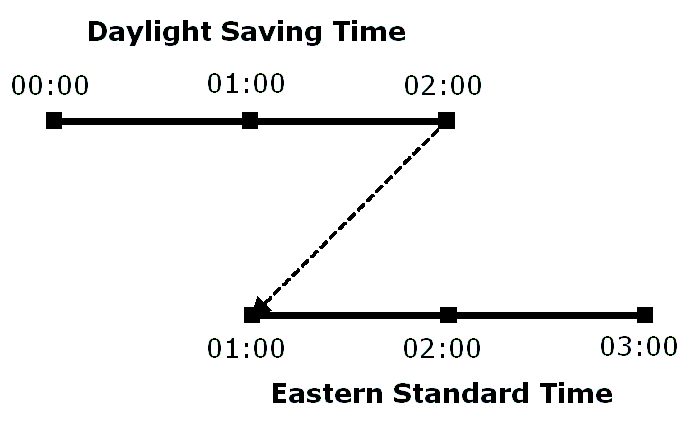
Events that are scheduled during the fall-back transition period (1:00 a.m. to 2:00 a.m. time period on the day fall back occurs) will not run twice. For example, on the day fall back occurs, 1:15 a.m. occurs twice spaced one hour apart. The first time, 1:15 a.m. occurs on the DST scale; the second time, 1:15 a.m. occurs on the EST scale. Events always run during the second time interval (Standard scale). In this case, the Event runs at 1:15 a.m. EST.
For example, at 12:40 a.m. on November 4, 2007, you define an Event with a schedule criteria of HOURLY. At 1:59:59 a.m. DST, the time falls back to 1:00 a.m. EST. The server triggers the Event at 1:00 a.m. EST, not one hour earlier at 1:00 a.m. DST.
Note: You can simulate your Applications and generate a forecast report for the day fall back occurs to find out which jobs run and when Events are scheduled on that day.
|
Copyright © 2014 CA Technologies.
All rights reserved.
|
|