

By default, the server calculates an Application's critical path based on the job that finishes last in the Application. You can also identify a job in an Application as critical. The longest path to that job, based on historical execution time, is the critical path.
The server determines the critical path when it generates an Application. The critical path is dynamic; it changes as the Application runs.
Note: If none of the jobs in the Application have an average execution time when the Application runs, the server does not calculate the critical path of the Application. In future runs, the server calculates the critical path based on the historical execution times of each job in the Application.
Example: Critical Path of an Application
An Application has historical execution times for each job. The longest path to job Z is 130 minutes through jobs A, B, X, Y, and Z. The critical path in this Application, at this time, consists of jobs A, B, X, Y, and Z.
The following illustration displays the Application's critical path:
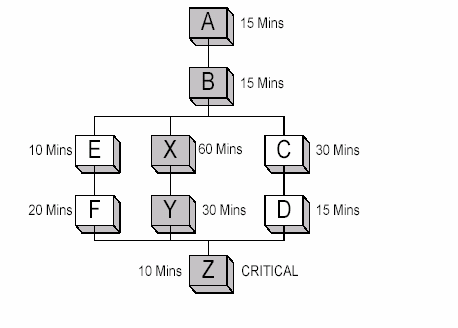
The critical path for an Application can vary depending on the jobs selected.
The following table displays the Application's critical path when certain jobs are not selected:
|
Jobs Not Selected |
Critical Path |
|---|---|
|
X, Y |
A, B, C, D, Z |
|
X, Z |
A, B, C, D |
|
X, Y, D |
A, B, E, F, Z, and A, B, C, Z |
|
Z |
A, B, X, Y |
|
Copyright © 2014 CA Technologies.
All rights reserved.
|
|