

The first step in planning your environment is to determine how many CA User Activity Reporting Module servers you need and what role each server will perform. Roles include:
Stores predefined and user-defined content and configurations. Also authenticates users and authorizes feature access.
Receives event logs from its agents; refines events.
Receives event logs from agents or collection servers; filters events and creates incidents according to its applied correlation rules.
Processes queries on collected events, both on-demand queries and reports and also scheduled alerts and reports.
Receives restored event log databases for investigation of past events
The first server you install is the management server; this server can perform other roles as well. You can have only one management server in a single CA User Activity Reporting Module network. Every CA User Activity Reporting Module network must have one management server.
Possible architectures include:
Details on server roles and architectures follow.
A CA User Activity Reporting Module system can have one or more servers. Dedicating different servers to different roles optimizes performance. But, you can use any server to perform multiple roles or all roles, at your discretion. Consider the processing burden associated with each server role with regard to other relevant factors in your environment when determining how to dedicate each server you install.
The management server role is, by default, performed by the first CA User Activity Reporting Module server you install. The management server performs these major functions:
There can be only one active management server in a CA User Activity Reporting Module network of servers, but you can have a failover (inactive) management server. If you create more than one CA User Activity Reporting Module network, each must have its own active management server.
In a single-server system, the management server performs the role of a collection server. In a system of two or more servers, consider a dedicated collection server. A collection server performs these functions:
Important! When you dedicate separate servers to collection and reporting, you must configure non-interactive authentication and hourly auto archiving from the collection server to the reporting server.
Consider the event volume generated by your event sources when determining whether to dedicate servers to event collection and refinement. Also consider how many collection servers are to auto-archive their data to a single reporting server.
In a single-server system, the management server performs the role of a correlation server. In a system of two or more servers, consider a dedicated correlation server. A correlation server performs these functions:
Important! When you dedicate separate servers to correlation, you must select every collection server whose events you want to correlate when configuring the correlation service.
In a single-server or two-server system, the management server performs the role of a reporting server. In a system with many servers, consider dedicating one or more servers to reporting. A reporting server performs these functions:
If you plan to generate many complex reports and alerts on a server with high on-demand activity, consider dedicating a server to reporting.
A remote storage server, which may not be a CA User Activity Reporting Module server, performs this function:
Remote storage servers are never part of a CA User Activity Reporting Module federation. However, they deserve consideration when you plan your architecture.
Reporting servers typically act as restore point servers for the databases they once held. If your network is large, consider dedicating a CA User Activity Reporting Module server to this role. A restore point server performs these functions:
The advantage of having a dedicated restore point is that you can exclude this server from your federation to ensure that no federated reports contain old, restored data. All reports generated on the restore point server reflect only event data from the restored databases.
Dedicating a server to a certain role does not mean you cannot perform functions from it that are associated with other roles. Consider an environment with dedicated collection servers and a reporting server. If you want to schedule an alert to check for a condition on a collection server because it is time-critical that you be notified as soon as possible, you have this flexibility.
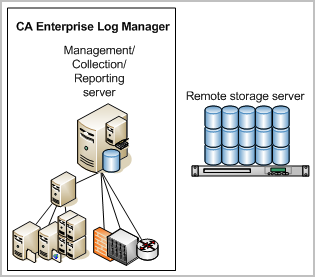
The simplest CA User Activity Reporting Module architecture is a single-server system, where one CA User Activity Reporting Module server performs all roles:
Note: A non-CA User Activity Reporting Module remote server stores archived event log databases.
This setup is appropriate for processing a low event volume and few scheduled reports, as in a test system.
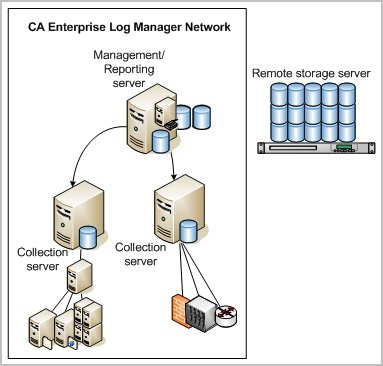
The next simplest architecture is a multi-server system where the first CA User Activity Reporting Module installed performs most roles:
Note: A non-CA User Activity Reporting Module remote server is set up to store archived databases of event logs.
This architecture is suitable for a network with moderate event volume. The arrows depict that the management functionality of the Management/Reporting server maintains the global settings that apply to all servers. When there are many collection servers, this architecture is termed "hub and spoke."
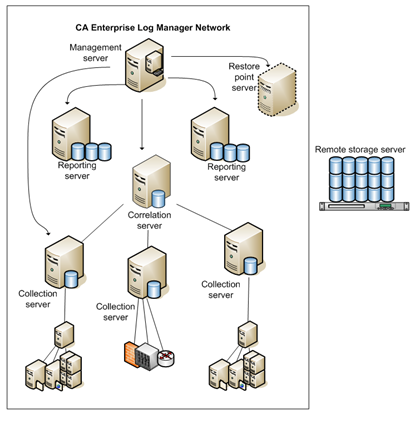
In a large network with high event volume, many complex scheduled reports and alerts, and ongoing customization, you can dedicate one or more CA User Activity Reporting Module servers to single roles:
Note: A non-CA User Activity Reporting Module remote server is set up to store archived databases of event logs.
This setup is ideal for very large networks. The arrows depict that the Management server maintains the global settings that apply to all servers.
|
Copyright © 2014 CA Technologies.
All rights reserved.
|
|