

The process you follow to rapidly deploy a virtual CA User Activity Reporting Module server for collection includes the following procedures:
Important! If you want to provision a CA User Activity Reporting Module server using the virtual appliance, the Application Instance Name of the primary CA User Activity Reporting Module server must be CAELM.
The distribution image for the CA User Activity Reporting Module virtual appliance is available from Support Online from the Downloads link. There are five files that you must download:
When you install the virtual appliance silently, you must perform the following tasks:
The following table describes the parameters used to deploy CA User Activity Reporting Module using the OVF tool. You must specify these parameters as command line arguments in the command line.
|
Required information |
Value |
Comments |
|---|---|---|
|
Host Specific Settings |
||
|
HOSTNAME |
hostname for this CA Enterprise Log Manager server For example: CA-ELM1 |
Specify the host name for this server using only supported characters for hosts. Industry standards recommend A-Z (case-insensitive), 0-9, and hyphen, where the first character is a letter and the final character is alphanumeric. Do not use the underscore character in a host name, or append a domain name to this host. Note: The host name must not exceed 15 characters. |
|
ROOT_PASSWORD |
new root password |
Create and confirm a new root password for this server. |
|
IP_ADDRESS |
relevant IPv4 address |
Enter a valid IP address for this server. |
|
SUBNET_MASK |
relevant IP address |
Enter a valid subnet mask for use with this server. |
|
DEFAULT_GATEWAY |
relevant IP address |
Enter a valid subnet mask and default gateway for use with this server. |
|
DNS_SERVERS |
relevant IPv4 addresses |
Enter one or more DNS server IP addresses in use in your network. The list is comma-separated with no spaces between entries. If your DNS servers use IPv6 addressing, enter these addresses in that format. |
|
DOMAIN_NAME |
your domain name |
Enter the qualified domain name in which this server operates, for example, mycompany.com. Note: The domain name must be registered with the Domain Name Server (DNS) server in your network to enable resolution of the hostname to IP address. |
|
acceptAllEulas |
Accept |
Accept the CA license agreement to continue provisioning a CA User Activity Reporting Module server. |
|
deploymentOption |
medium or large |
If you select medium, VMware provides four CPUs with 8 GB RAM for each CPU. If you select large, VMware provides eight CPUs with 8 GB RAM for each CPU. |
|
TIMEZONE |
your desired time zone |
Select the time zone where this server resides. |
|
NTPLOCATION |
relevant hostname or IP address |
Enter the host name or the valid IP address of the NTP server from which the CA User Activity Reporting Module server gets date and time information. |
|
Application Specific Settings |
||
|
LOCAL_REMOTE_EEM |
Local - for the first installed server (management server)
Remote - for each additional server |
Indicate whether you plan to use a local or a remote CA EEM server. For a management CA User Activity Reporting Module server, choose Local. The installation prompts you to create a password for the default EiamAdmin user account. For each additional server, choose Remote. The installation prompts you for the management server name. Regardless of whether you chose local or remote, you must use the EiamAdmin account ID and password to log on to each CA User Activity Reporting Module server the first-time. |
|
REMOTE_EEM_LOCATION |
IP address or hostname |
Enter this value only if you select Remote in the Local or Remote server option. Enter the IP address or host name of the management CA User Activity Reporting Module server that you installed first. The host name must be registered with the DNS Server. If you want to use a local CA EEM server, the default value is none. |
|
EEM_PASSWORD |
EiamAdmin account password |
Record the password for the default administrator account, EiamAdmin. Your CA User Activity Reporting Module server requires these account credentials for the initial login. If you are installing the management server, you are creating and confirming a new EiamAdmin password here. Make a note of this password as you must use it during the installations of other CA User Activity Reporting Module servers and agents. Note: The password you enter here is also the initial password for the default caelmadmin account that you use to access the CA User Activity Reporting Module server directly through ssh. You can create additional administrator accounts to access the CA EEM functions after installation, if desired. |
|
FIPS_MODE |
Yes or No |
Specifies if the virtual appliance must run in FIPS mode or non-FIPS mode. If you choose to use a local CA EEM server, you can choose any mode. If you choose to use a remote CA EEM server, you must choose the mode that the remote CA EEM server uses. |
Note: You must install the OVF Tool 4.0.0 before you perform the silent installation.
You can install multiple CA User Activity Reporting Module servers simultaneously by creating and running scripts containing the commands that invoke the OVF tool. You can use any scripting language to create scripts.
To invoke OVF tool using scripts
The message Opening VI target is displayed. The deployment status of each CA User Activity Reporting Module server is displayed. If the installation is successful, a CA User Activity Reporting Module server is listed under the datastore you selected in the left pane.
Example 1: Batch Script for creating a primary CA User Activity Reporting Module server and a secondary CA User Activity Reporting Module server
REM Primary CA User Activity Reporting Module Server
ovftool -dm=thin --acceptAllEulas --name="example_primaryserver" --deploymentOption=medium --prop:ROOT_PASSWORD="example_password" --prop:LOCAL_REMOTE_EEM=Local --prop:REMOTE_EEM_LOCATION=none --prop:EEM_PASSWORD=calmr12 --prop:FIPS_MODE=Yes --prop:IP_ADDRESS=172.162.0.0 --prop:SUBNET_MASK=10.0.0.0 --prop:HOSTNAME="example_primary_server" --prop:DEFAULT_GATEWAY=198.168.0.0 --prop:DNS_SERVERS=198.168.10.20,198.168.10.25 --prop:DOMAIN_NAME=example.com --prop:TIMEZONE=Asia/Kolkata --prop:NTPLOCATION=198.168.10.30 "C:\Program Files\CA ELM\CA Enterprise Log Manager.ovf" "vi://administrator:password@examplevmwarehost/ELMQAvAppDatacenter/host/10.0.10.0"

REM Secondary CA User Activity Reporting Module Server
ovftool -dm=thin --acceptAllEulas --name="example_secondaryserver" --deploymentOption=medium --prop:ROOT_PASSWORD="example_password1" --prop:LOCAL_REMOTE_EEM="Remote" --prop:REMOTE_EEM_LOCATION="example_primaryserver" --prop:EEM_PASSWORD="calmr12" --prop:FIPS_MODE="Yes" --prop:IP_ADDRESS="172.168.10.10" --prop:SUBNET_MASK="10.0.10.10" --prop:HOSTNAME="example_secondary_server" --prop:DEFAULT_GATEWAY="198.168.10.30" --prop:DNS_SERVERS="198.168.20.20,198.168.20.25" --prop:DOMAIN_NAME="example.com" --prop:TIMEZONE="Asia/Kolkata" --prop:NTPLOCATION=198.168.10.30 "C:\Program Files\CA ELM\CA Enterprise Log Manager.ovf" "vi://administrator:password@examplevmwarehost/ELMQAvAppDatacenter/host/10.0.10.0"
Example 2: Batch Script for creating a management server and two collection servers
REM CA User Activity Reporting Module Management Server
ovftool -dm=thin --acceptAllEulas --name="example_managementserver" --deploymentOption=medium --prop:ROOT_PASSWORD="example_password" --prop:LOCAL_REMOTE_EEM=Local --prop:REMOTE_EEM_LOCATION=none --prop:EEM_PASSWORD=calmr12 --prop:FIPS_MODE=Yes --prop:IP_ADDRESS=172.168.0.0 --prop:SUBNET_MASK=10.0.0.0 --prop:HOSTNAME="example_management_server" --prop:DEFAULT_GATEWAY=198.168.0.0 --prop:DNS_SERVERS=198.168.10.20,198.168.10.25 --prop:DOMAIN_NAME=example.com --prop:TIMEZONE=Asia/Kolkata --prop:NTPLOCATION=198.168.10.30 "C:\Program Files\CA ELM\CA Enterprise Log Manager.ovf" "vi://administrator:password@examplevmwarehost/ELMQAvAppDatacenter/host/10.0.10.0"

REM CA User Activity Reporting Module Collection Server 1
ovftool -dm=thin --acceptAllEulas --name="example_collectionserver1" --deploymentOption=medium --prop:ROOT_PASSWORD="example_password1" --prop:LOCAL_REMOTE_EEM=Remote --prop:REMOTE_EEM_LOCATION="example_managementserver" --prop:EEM_PASSWORD=calmr12 --prop:FIPS_MODE=Yes --prop:IP_ADDRESS=172.168.10.10 --prop:SUBNET_MASK=10.0.10.10 --prop:HOSTNAME="example_collection_server1" --prop:DEFAULT_GATEWAY=198.168.10.30 --prop:DNS_SERVERS=198.168.20.20,198.168.20.25 --prop:DOMAIN_NAME=example.com --prop:TIMEZONE=Asia/Kolkata --prop:NTPLOCATION=198.168.10.30 "C:\Program Files\CA ELM\CA Enterprise Log Manager.ovf" "vi://administrator:password@examplevmwarehost/ELMQAvAppDatacenter/host/10.0.10.0"

REM CA User Activity Reporting Module Collection Server 2
ovftool -dm=thin --acceptAllEulas --name="example_collectionserver2" --deploymentOption=medium --prop:ROOT_PASSWORD="example_password2" --prop:LOCAL_REMOTE_EEM=Remote --prop:REMOTE_EEM_LOCATION="example_managementserver" --prop:EEM_PASSWORD=calmr12 --prop:FIPS_MODE=Yes --prop:IP_ADDRESS=172.168.10.30 --prop:SUBNET_MASK=10.0.10.40 --prop:HOSTNAME="example_collection_server2" --prop:DEFAULT_GATEWAY=198.168.10.40 --prop:DNS_SERVERS=198.168.30.30,198.168.30.25 --prop:DOMAIN_NAME=example.com --prop:TIMEZONE=Asia/Kolkata --prop:NTPLOCATION=198.168.10.30 "C:\Program Files\CA ELM\CA Enterprise Log Manager.ovf" "vi://administrator:password@examplevmwarehost/ELMQAvAppDatacenter/host/10.0.10.0"
After you import the OVF template, you must manually set the resource settings to improve the performance of the provisioned CA User Activity Reporting Module server.
Note: Verify that you set the CD/DVD Drive to Client Device.
Follow these steps:
The <CA User Activity Reporting Module Virtual Appliance name> - Virtual Machine Properties window appears.
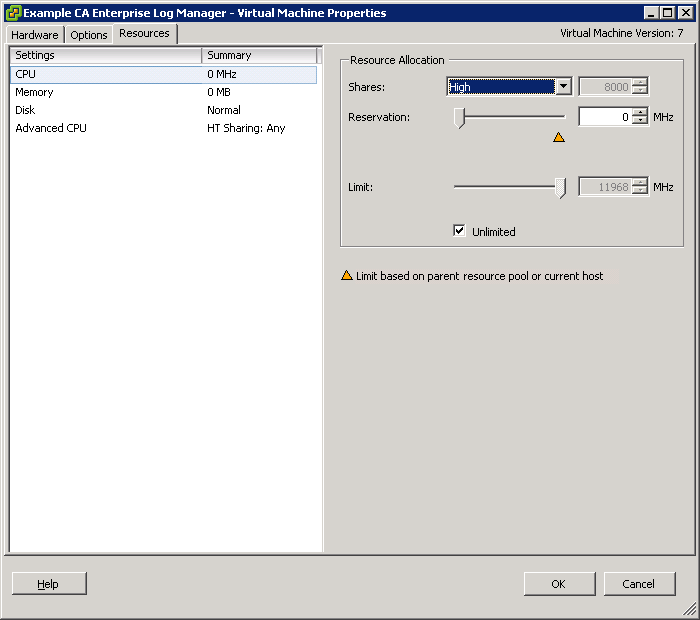
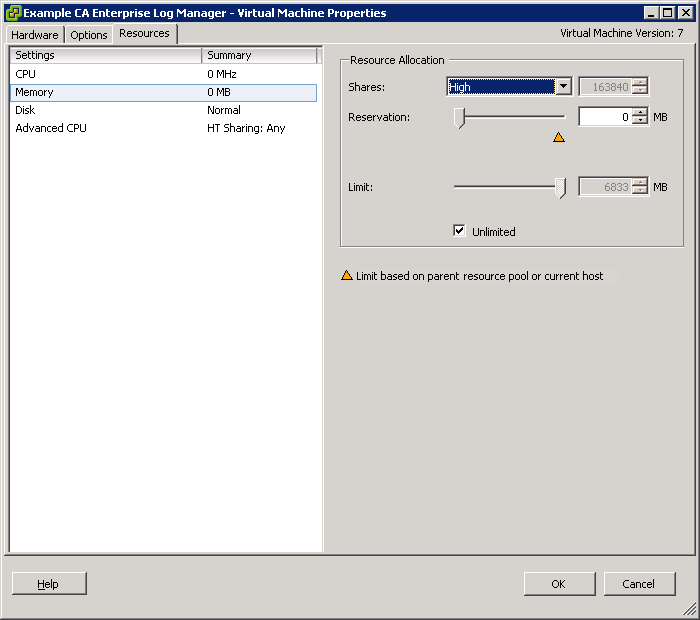
Note: For more information about the Resource settings, go to www.vmware.com.
You must power on the CA User Activity Reporting Module server to start running it.
To power on a CA User Activity Reporting Module server
The CA User Activity Reporting Module server is powered on.
Note: Verify that a primary CA User Activity Reporting Module server is running before you power on a secondary CA User Activity Reporting Module server.
When you power on the provisioned CA User Activity Reporting Module server, a URL to access CA User Activity Reporting Module is displayed in the Console tab of the VMware vSphere Client window. Use this URL and the following default login credentials to access CA User Activity Reporting Module:
Default Username: EiamAdmin
Default Password: The password you entered during the CA User Activity Reporting Module server installation procedure
|
Copyright © 2014 CA Technologies.
All rights reserved.
|
|