

Business partners have their own method of defining user identity in their respective user stores. How users are identified determines how one partner can map its users to the other partner.
Consider the following scenarios:
Account linking is the method of user identification.
Identity mapping is the method of user identification. At FinancePro, a customer is identified as JohnDoe, while at BankLtd this same customer is identified as DoeJ. The partners must agree on a user attribute profile to use for identity mapping.
Account provisioning is the method for user identification. Provisioning an account can require creating an account for a user or simply populating an existing user account with information in the SAML assertion.
The user identification decision determines what information is sent as the user identity in the assertion.
When a customer at FinancePro accesses a resource at BankLtd, the NameID is always in the assertion. This identifier allows BankLtd to determine who the customer is and the level of access to allow for that customer.
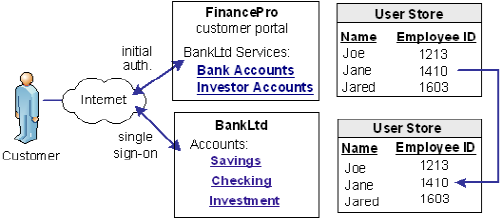
The NameID can establish a federated identity when the user store at each partner identifies the users in the same way with the same ID.
The following figure shows the user store at each site with the same employee IDs.
CA SiteMinder® Federation Standalone lets you configure account linking as part of the partnership configuration process. You specify a NameID format and Name ID type, which determines the type of value that defines the Name. You associate the specific Name ID type, with a static, user, or DN attribute from a user directory. The NameID that CA SiteMinder® Federation Standalone includes in the assertion conforms to the configuration you define.
When the relying party receives the assertion, the user disambiguation process at BankLtd occurs. The process links the NameID value in the assertion to a record in its user store.
An investor at Financepro authenticates and selects a link to access information at BankLtd. The investor is taken directly to the accounts area of the BankLtd website without having to sign on.
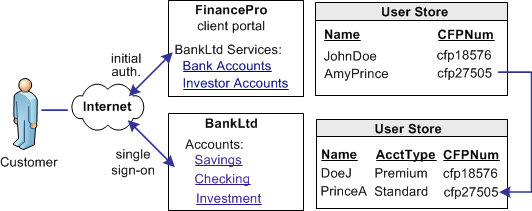
BankLtd maintains user identities for all customers at Financepro, but the identities differ from the identities at FinancePro. For example, at FinancePro, JohnDoe is a customer. At BankLtd, this same customer is identified as DoeJ. Regardless, BankLtd must control access to sensitive portions of the company website. To establish the federated identity, the partners agree on an attribute that maps to the appropriate identity for a single customer at either site.
The partners agree on which attribute to use during an out-of-band exchange of information, meaning that the agreement is not part of any communication in any message over a channel. For this example, the attribute that the partners agree upon is a certified financial planner license number, referred to as the CFPNum in each user store.
When a customer tries accessing the federated resource at BankLtd, the request triggers the single sign-on process. The assertion that is generated at FinancePro contains the CFPNum attribute. When BankLtd receives the assertion, an application at its site has to perform the user disambiguation process. The process relies on the attribute to determine which profile identity is used for the request.
The following illustration shows how the same users are identified differently at each partner.
CA SiteMinder® Federation lets you configure identity mapping as part of the partnership configuration process. For the NameID and attribute configuration, you define an attribute called CFPID. Associate this attribute with the user attribute CFPNum, which is the name of the attribute in the user store at each partner.
CA SiteMinder® Federation includes the attribute in the assertion. When BankLtd receives the assertion, the user disambiguation process links the attribute in the assertion to the appropriate record in its user store.
|
Copyright © 2013 CA.
All rights reserved.
|
|