

CA SiteMinder® Federation Standalone Installation and Upgrade Guide › Install CA SiteMinder® Federation Standalone › How to Run the CA SiteMinder® Federation Standalone Configuration Wizard › CA SiteMinder® Federation Standalone Deployment with CA SiteMinder® › Proxy Mode with the SiteMinder Connector at the Relying Party
Proxy Mode with the SiteMinder Connector at the Relying Party
If CA SiteMinder® Federation Standalone is communicating with CA SiteMinder® in proxy mode, all requests still pass through CA SiteMinder® Federation Standalone; however, CA SiteMinder® Federation Standalone has to establish a CA SiteMinder® session with the Policy Server so that when the user requests CA SiteMinder®-protected resources he is not rechallenged. The request is redirected to the target web server, which is protected by a CA SiteMinder® Web Agent.
The following graphic shows a proxy mode architecture with the CA SiteMinder® Connector. This graphic is from the perspective of the relying party.
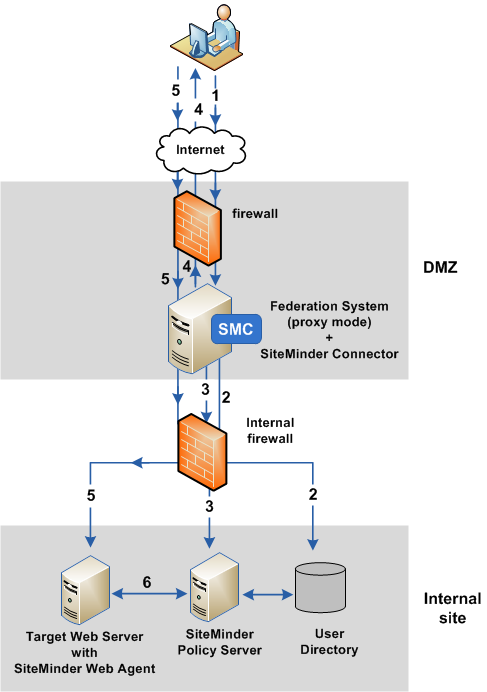
The previous figure shows the following communication flow at the relying party:
- A user requests a federated resource and is redirected to the relying party's assertion consumer service.
- Based on the data received in the assertion, CA SiteMinder® Federation Standalone authenticates the user, which includes communicating with the user directory to complete the user disambiguation process.
- The CA SiteMinder® Connector, as part of CA SiteMinder® Federation Standalone, contacts the custom authentication scheme at the CA SiteMinder® Policy Server. A CA SiteMinder® session ticket is created by the Policy Server, which it sends to CA SiteMinder® Federation Standalone. CA SiteMinder® Federation Standalone then creates a session cookie that includes the ticket. Establishing a CA SiteMinder® session ensures the user is not challenged later when accessing the target resource.
- CA SiteMinder® Federation Standalone returns a redirect response back to the user's browser.
- The browser redirects the user to CA SiteMinder® Federation Standalone and CA SiteMinder® Federation Standalone proxies the request to the web server with the target resource, which is protected by the CA SiteMinder® Web Agent.
- The CA SiteMinder® Web Agent and Policy Server perform the authorization process.
After successful authorization, the target resource is presented to the user's browser.
Copyright © 2013 CA.
All rights reserved.
|
|