

Service Modeling Examples and Scenarios › Service Modeling Example 2- Shopping Cart Service › Shopping Cart Service Model
Shopping Cart Service Model
The managed service provider imports the Shopping Cart service from CA CMDB. The service appears in CA SOI as shown in the following graphic:
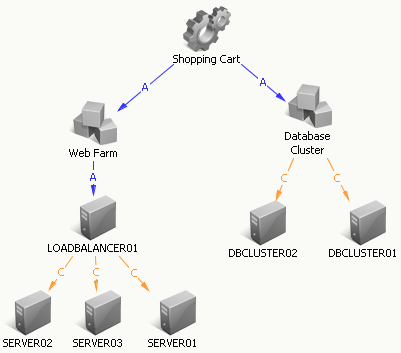
The Shopping Cart service has the following characteristics:
- Logical groups represent the two main resource domains: the web server farm and the database cluster. The groups use aggregate propagation to the service as shown by the letter A on the arrows connecting the CIs.
- The CIs in the web server farm and database cluster use custom propagation as shown by the letter C on the arrows connecting the CIs. Each group of CIs has an associated custom propagation policy that specifies the conditions under which to propagate impact to the related CI (LOADBALANCER01) or group (Database Cluster). Custom propagation policy takes into account that if one server in a cluster or web farm fails, this should not have a severe impact on the service, as long as the other servers are running at peak performance.
- The managed service provider has created escalation policy that opens a CA Service Desk ticket when a service alert occurs.
- CA Application Performance Management and CA Application Configuration Manager track important service-level metrics and compliance information for the service and associated CIs. If necessary, the managed service provider could also create an SLA for the service that tracks performance against service health, quality, risk, or availability.
Copyright © 2013 CA.
All rights reserved.
|
|