

Many installations deploy a clustered Domain Orchestrator for high availability and scalability of the deployment.
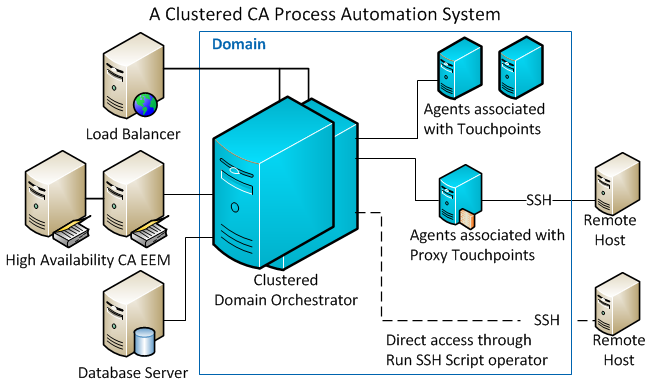
A clustered Orchestrator consists of two or more nodes. In normal operations, workload is shared across the nodes of the Orchestrator. Additional nodes can be added to scale out the capacity of the Orchestrator as needed. In the event of the failure of an Orchestrator node, the other nodes take over the responsibilities of the failed node until it recovers, providing High Availability.
Each Orchestrator node is installed on a different host. You install and upgrade each node separately.
Note: If you previously installed an Orchestrator initially in a standalone configuration, it is necessary to rerun the installation wizard to reconfigure it as a node of a clustered Orchestrator.
CA Process Automation supports both hardware load balancers and software load balancers, for example:
Note: The Apache load balancer is supported for communication between upgraded agents and a clustered Orchestrator. However, the Apache load balancer does not support the protocol that the simplified communications mechanism requires. You can continue using the deprecated communication model with Apache, but if you plan to deploy with a software load balancer, it is strongly recommended that you use NGINX.
CA EEM can be configured with a failover node for deployments requiring a full high availability configuration.
|
Copyright © 2014 CA.
All rights reserved.
|
|