

In general, MVS provides information about the performance of batch jobs by using the following components:
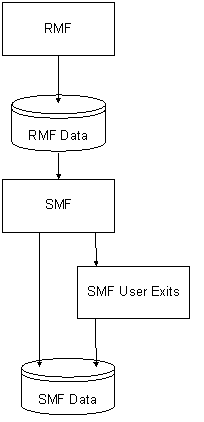
RMF provides information related to the physical CPU environment, for example, processor utilization of address spaces, I/O wait times, and so on. Such information is presented at the address space level. Because a batch job can have more than one address space, there is usually no direct correlation between a specific batch job of interest and the information provided.
On the other hand, SMF provides information about the system activity, for example, started jobs, I/O requests issued from a job, and so on. SMF writes this information to SMF data sets, which can be later inspected offline with SAS or other user-written analysis procedures. SMF also writes the data collected by RMF to its own SMF data sets.
Analyzing SMF data offline is not desirable for controlling the performance of an MVS batch environment because the length of time between the analysis and the point of time where an action must be initiated is too long. The switching of SMF data sets is installation and activity dependent.
However, SMF provides a number of user-exits where performance control can hook into and analyze the SMF data at the point when they are created and before the SMF data is written out to the SMF data set. The user-exit candidates for performance control are as follows:
This exit is called by SMF whenever a job is selected for execution by JES. For performance control, this exit can be used to filter out jobs of interest.
This exit is called by SMF whenever a job step is set up by an initiator. For performance control, this exit can be used to filter out job steps of interest and (main) programs of interest.
This exit is called by SMF whenever a job step is terminated by the terminator. For performance control, this exit can be used to obtain accumulated data for CPU time, SRB time, service units, EXCPs, and so on.
This exit is called by SMF whenever a job is abnormally terminated. For performance control, this exit can be used to delete jobs of interest from the watch list and write accumulated data for historical purposes.
This exit is called by SMF whenever a record is created. For performance control, this exit is the most interesting one. Provided that the correlation between address spaces and currently active job steps are set up, performance control can monitor the resource utilization within the intervals because RMF provides the processor utilization data. This process results in very precise activity measurement of the job step of interest and recognition when a job step exceeds its limits. Additionally, all information presented by SMF is available for selection to create individual performance statistics.
|
Copyright © 2012 CA Technologies.
All rights reserved.
|
|