
This section contains the following topics:
RMFMC4 - Daily z/OS LPAR MSU Use Cap and 4 Hour Avg
RMFMCL - Daily LPAR MSU Use and Capacity Limits
RMFMMC - Monthly LPAR MSU Use and Capacity Limits
RMFMSU - Daily CPC MSU Use with Stacked LPARs
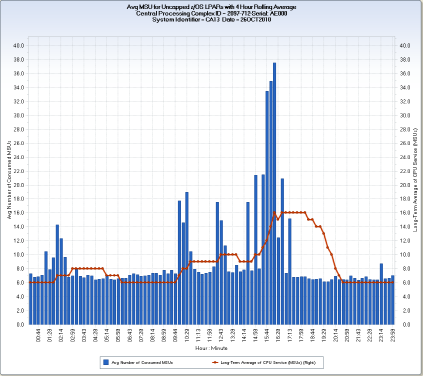
The RMFMC4 query shows the average MSU usage of z/OS LPARs at the RMF interval level and includes the four hour rolling MSU average. All z/OS LPARs are accounted for. This query is similar to the RMFMCL query previously described, but has the additional benefit of showing the four hour rolling MSU average which is only available for z/OS LPARs. The query generates two separate data extracts. One for z/OS LPARs that have defined capacity limits, and the other for z/OS LPARs with no defined capacity limits. One of the uncapped LPARs for each CPC is the ‘PHYSICAL’ LPAR that captures PR/SM overhead.
The top example shows the average MSU usage chart for a z/OS LPAR (PRSMLPNM=’CA31’) running on an IBM z/10 2097-712 CPC. The RMF intervals records were generated at 15-minute intervals, and the LPAR has a defined capacity limit of 455 MSUs. The second example shows the average MSU usage chart for another LPAR (PRSMLPNM=’CA13’) on the same CPC. The RMF intervals records were also generated at 15-minute intervals. This second LPAR has no defined capacity limit.
The processing capacity of mainframe CPCs is expressed in MSUs (Millions of Service Units per Hour). One of the characteristics of a specific CPC model is its MSU capacity. This capacity is indicative of its workload processing capability and is directly related to the number of general-purpose CP engines configured. Each LPAR that is assigned logical CP processors uses some amount of the available CPC MSUs. The MSU capacity of a CPC and of individual LPARs can influence the cost of software licensed to run on LPARs. Some software licensing costs can be lowered by defining a capacity limit for an LPAR. The limit prevents the LPAR from using the full MSU capacity associated with the logical processors assigned to it. The RMFMC4 charts can be used to monitor the normal MSU consumption of LPARs that use general-purpose CP engines, and also to determine the appropriate value to use for a defined capacity limit. The four hour rolling average is helpful because LPARs are allowed to exceed the defined limit, without penalty, as long as the four hour rolling MSU average stays below the defined limit. For example, if the daily MSU usage shown for the LPAR in the top example (PRSMLPNM=’CA31’) is consistent, over time, it means that the limit of 455 MSUs is set too high. A defined capacity limit of about 330 to 340 MSUs is a more appropriate setting for this LPAR—given that the peak four-hour rolling average was 322 MSUs.
Daily MSU Use for Cap z/OS LPARs 4H Avg

All LPARs in this data extract have defined capacity limits. If no LPARs in any CPCs have defined capacity limits, a single chart is produced with a CPCID of ‘NO Capped LPARS’ and an LPAR name of ‘NADA.’
CPUAVMSU – Avg Number of Consumed MSUs
CPUAVLAC – Long-Term Average of CPU Service (MSUs)
CPUDEFLM – Partition Defined Capacity Limit
HHMM – Hour : Minute
Data element HHMM is derived by concatenating the HOUR and MINUTE of each RMF interval together, separated by a colon, HH:MM (for example, 14:59 meaning hour 14, 59th minute).
Daily MSU Use for Uncap z/OS LPARs 4H Avg

All LPARs in this data extract have no defined capacity limits. There is always at least one LPAR in this data extract for each CPC—the ‘PHYSICAL’ LPAR which shows PR/SM overhead.
CPUAVMSU – Avg Number of Consumed MSUs
CPUAVLAC – Long-Term Average of CPU Service (MSUs)
HHMM – Hour : Minute
Data element HHMM is derived by concatenating the HOUR and MINUTE of each RMF interval together, separated by a colon, HH:MM (for example, 14:59 meaning hour 14, 59th minute).
TRIM(LPCMOD)||'-'||TRIM(CPCMODID)||'-Serial: '||SUBSTR(CPCSEQNB,12,5);
DATEPART(ENDTS);
PUT(HOUR(ENDTS),Z2.) || ':' || PUT(MINUTE(ENDTS),Z2.);
The following modifications can be made to the RMFMC4 query:
| Copyright © 2011 CA. All rights reserved. | Email CA Technologies about this topic |