

Determines Abend Trapping
When a task abends or when a program checks occurs, the setting of program currency determines whether or not the debugger traps the abend and transfers control to you.
DC/UCF and Debugger Currency
The DC/UCF system assigns currency on the basis of the most recent program to have been given control with #LINK or #XCTL program control services.
The debugger assigns currency according to these rules:
Sample Program Structure
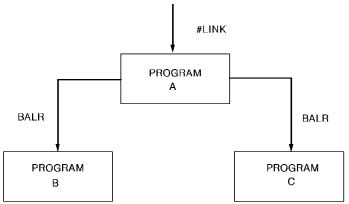
The following examples illustrate how program currency can affect whether the DC/UCF system passes control to the debugger. Each of the examples is based on the sample program structure:
Sample Program Structure for Examples
Example 1
During the setup phase, you define Programs A, B, and C to the debugger. When the program is executing, a program check occurs in Program B.
These currencies are now in effect:
You receive control under the debugger because Program B, one of the programs defined to the debugger, contains the address of the interrupt.
Example 2
During the setup phase, you define Program A to the debugger. When the program is executing, a program check occurs in Program B.
These currencies are now in effect:
You receive control under the debugger because the current DC/UCF program has also been defined to the debugger.
Example 3
During the setup phase, you define Program C to the debugger. When the program is executing, a program check occurs in Program B.
These currencies are now in effect:
You do not receive control under the debugger because no debugger currency can be set. The program abends without an interruption from the debugger, and the system issues a standard abend message.
Example 4
During the setup phase, you define Program A to the debugger. During execution, Program B branches into unknown storage and a program check occurs.
These currencies are now in effect:
You receive control under the debugger because the current DC/UCF program has also been defined to the debugger.
|
Copyright © 2013 CA.
All rights reserved.
|
|