

Access Data in One Direction
In a unidirectional relationship, access can go in only one direction: from a logical child segment to its logical parent segment. A logical child segment cannot be accessed from its logical parent.
Unidirectional Structure
The illustration below illustrates the unidirectional logical structure. The structure shown involves segments from both of the physical hierarchies (PHYSDB1 and PHYSDB2) defined in earlier in this section. The logical child is SEG6 (in PHYSDB2), the physical parent is SEG5 (also in PHYSDB2), and the logical parent is SEG1 (in PHYSDB1).
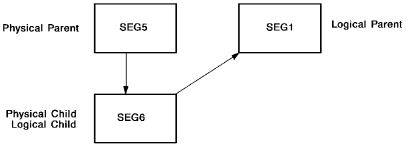
Figure 10. Unidirectional structure
Defining a Unidirectional Structure
You define a unidirectional structure in the logical child's SEGM statement. The SEGM statement names the logical child segment and identifies both the physical parent and the logical parent.
The PARENT parameter on the logical child's SEGM statement takes the following form:
Syntax

Parameters
Identifies the name of a physical parent segment and must match a name specified for the NAME parameter in a preceding SEGM statement.
Identifies the name of a logical parent segment and must match the name specified for the NAME parameter on the logical parent's SEGM statement. Note that this SEGM statement can be in the same DBD or a different DBD (see Dbname below).
Specifies whether the concatenated key of the logical parent is stored with the logical child (PHYSICAL) or is built at run time (VIRTUAL). For more details, see IPSB Compiler.
Dbname is the name of the DBD that contains the logical parent's SEGM statement.
|
Copyright © 2013 CA.
All rights reserved.
|
|