

When walking a set containing prior pointers, if the prior db-key of a record occurrence does not point back to its prior record in the set, CA IDMS/DB Audit saves the db-key of the current record in a save table and continues set walking. At end-of-set, CA IDMS/DB Audit retrieves each saved db-key and attempts to walk prior from that point. This process of walking, saving, and retrieving db-keys is continued until all saved db-keys have been processed.
For example, in Figure 2.36, CA IDMS/DB Audit walks a set occurrence owned by ENGLISH. No error is detected until the David Lee record is retrieved: the prior db-key does not point to John Doe.
Since the David Lee record is the last member of the set and an integrity error was detected in the set, CA IDMS/DB Audit returns to the owner record, ENGLISH, and walks the set again, creating extract records for each record occurrence retrieved. When the David Lee record is retrieved, the record db-key is placed in the save table. CA IDMS/DB Audit continues set walking until end-of-set is reached. CA IDMS/DB Audit then retrieves the saved db-key and begins walking prior from the saved db-key to its prior record, Joan Brown.
The following situations demonstrate the effect of specifying DBKEYTBL or not:
In either case, CA IDMS/DB Audit then checks the save table for additional saved db-keys. After all saved db-keys have been processed, CA IDMS/DB Audit stops creating extract records for the set.
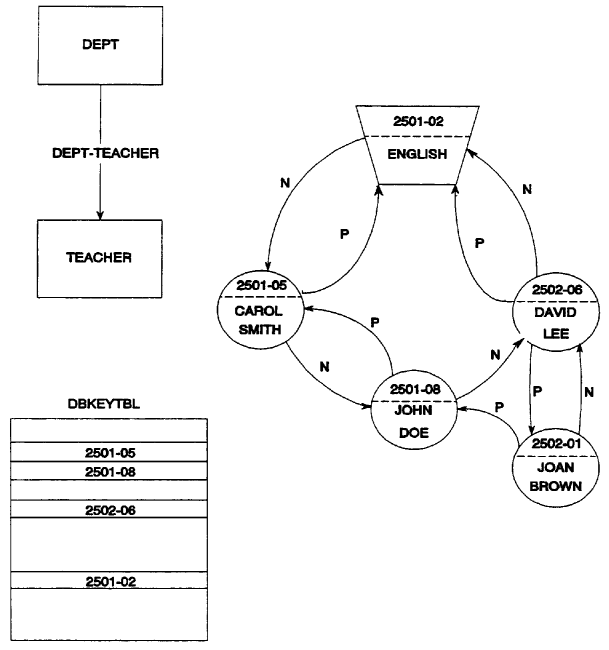
Figure 2.36: Set Walk, Prior Pointers
|
Copyright © 2013 CA.
All rights reserved.
|
|