

An object in the destination model is equivalent to an object in the source model if it has the same Original Encyclopedia ID and the same Original Object ID, or if there is a Special Equivalency Rule for that object type, and the object in question meets the rule.
The combination of an object's Original Encyclopedia ID and Original Object ID, which is unique within a model, defines that object's ancestry. If two aggregate objects in different models have the same Original Encyclopedia ID and Original Object ID, they share common ancestry. The two aggregate objects are considered versions of the same object.
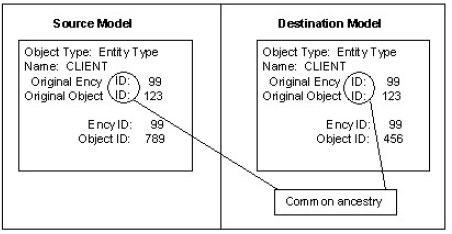
The following figure illustrates equivalence between two objects, due to common ancestry. The entity type, CLIENT, in the source model shares common ancestry with the entity type, CLIENT, in the destination model. Equivalence is established by matching Original Encyclopedia IDs and Original Object IDs:
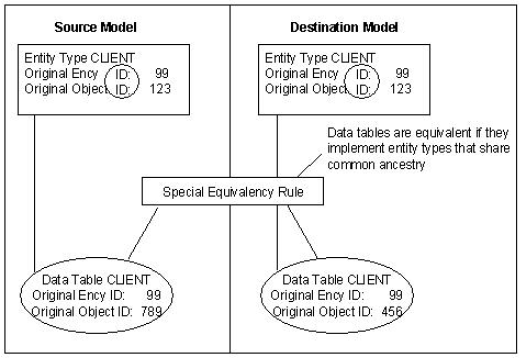
The figure, Object Equivalence Through Special Equivalency Rule, illustrates equivalence between objects that meet the special equivalency rule for data tables. The data table, CLIENT, in the source model is equivalent to data table, CLIENT, in the destination model. Equivalence between the data tables is established by the Special Equivalency Rule for data tables, which states that data tables are equivalent if they implement entity types that share common ancestry.
Note: You can find the other object types to which a special equivalency rule applies in the table Special Equivalency Rules. The rule for each object type is also provided.
|
Copyright © 2013 CA.
All rights reserved.
|
|