

One of the fundamental principles of GUI is that the design must be closely mapped to the user's needs. To accomplish this, it is essential to have a thorough understanding of the users' needs. You must also understand who the users are and how they will use the interface. This understanding must form the basis of the windows you design.
Traditional block mode interfaces reflect an expectation that tasks are linear in nature. In a linear program, a well-defined series of steps should lead to a single definable goal. For example, consider the role of a data entry operator assigned to type data as quickly and accurately as possible. Such a task is repetitive and linear in nature, which makes it better served by a simple block mode, form-driven interface.
Many tasks are not repetitive or linear. Consider a more open-ended task such as word processing a document. This task may involve accessing several sources of information, such as other word-processed documents for text, a spreadsheet for a data, and a graphics package for a diagram. The performance of the task involves the ability to make decisions and, as a result, requires an open task structure.
An open task structure is also needed when the data entry operator's work may be interrupted by some external business event. The operator may need to suspend the task while switching to a higher priority assignment.
The linear versus open-task models are summarized in the following illustration.
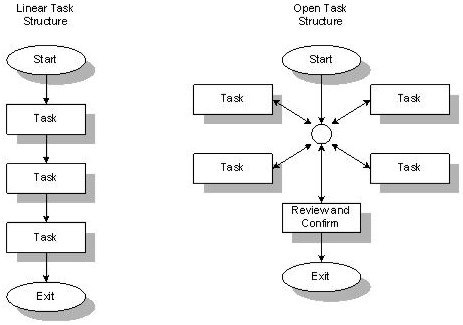
The linear task structure is task-oriented. Block mode interfaces tend to be task-oriented.
The open-task structure is user-oriented. Properly designed GUIs tend to be user-oriented.
You should be aware of this major distinction as you move into the world of GUI design if you normally build block mode interfaces.
A GUI allows a closer mapping to the user task structure in the following ways:
|
Copyright © 2013 CA.
All rights reserved.
|
|