

Any procedure requiring multiple screens to support the elementary processes it implements will need a procedure step for each screen.
Consider the example in the following illustration, Procedure With Two Procedure Steps.
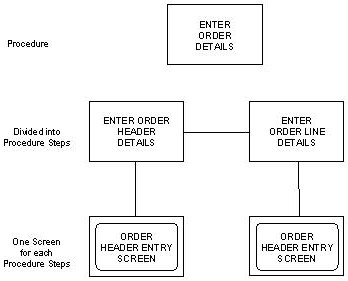
The example shows a single procedure called Enter Order Details. Assume that this procedure implements an elementary process called Take Order. The designer determines that the user needs to use two displays when taking an order: one to enter the base order information and another to enter order item details. As a result, two procedures are created to support the Enter Order Details procedure. These new procedure steps are Enter Order Header Details and Enter Order Item Details.
Whenever possible, you should implement online procedures in a single procedure step. Multi-step procedures can require more effort to develop and maintain than single-step ones, and splitting the results of transformation into multiple steps is largely a manual process.
Multi-step procedures may be appropriate when one of the following conditions occurs:
In all these situations the designer should carefully manipulate any action blocks developed during analysis, to ensure that the business requirement for the elementary process being implemented is not compromised. CA Gen does not automatically maintain the integrity of the elementary process once a procedure is divided into procedure steps.
It is important to ensure the integrity of the business across multiple procedure steps. We strongly recommended that you execute entity actions that will cause database modifications in the final procedure step. These entity actions are CREATE, UPDATE, and DELETE. In this way, interruption of a procedure between procedure steps will not leave the data partly updated, and therefore possibly in an inconsistent state.
|
Copyright © 2013 CA.
All rights reserved.
|
|