

Compressing the content that is transferred across the network can improve application performance. Compression reduces the number of bytes of data that is sent over the network, resulting in faster transfer. The faster download outweighs the cost of expanding the compressed response at the browser.
Dynamic HTTP compression reduces the size of HTML and JavaScript content returned to the browser. Dynamic HTTP compressions use the GZIP compression technique. The dynamic content is sent through a filter and compressed on-the-fly by the CA Gen runtime.
Dynamic HTTP decompression is a feature built directly into the browser. This feature does not require any plug-ins, and is enabled by default.
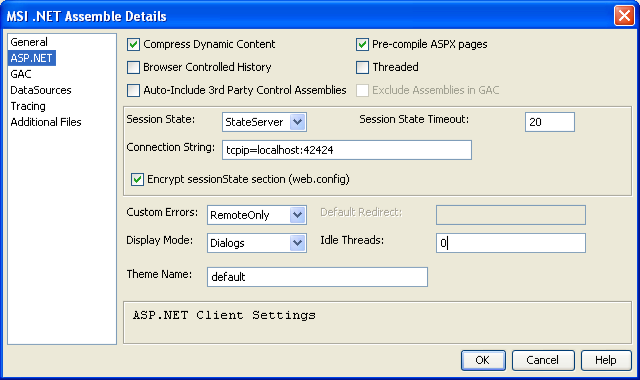
For CA Gen ASP.NET applications, you can enable or disable dynamic HTTP compression from the MSI.NET Assemble Details dialog in the Build Tool.
The following image illustrates the MSI.NET Assemble Details dialog in the Build Tool:
Note: For more information on dynamic HTTP compression, see the Build Tool Help.
|
Copyright © 2013 CA.
All rights reserved.
|
|