

|
|
|
Some directory implementations use individual bits in an attribute to provide information about that attribute, such as the state of an account. You can apply a bit mask to an attribute.
This use case shows two Active Directory user stores that identify disabled user accounts. Each account has a different underlying schema.
Note: Review the advanced user attribute mapping examples, which detail how to use different attribute mapping types to identify the same user attribute across different directory types.
The following illustration details how two mask attribute mappings can create a common view of the same user information.
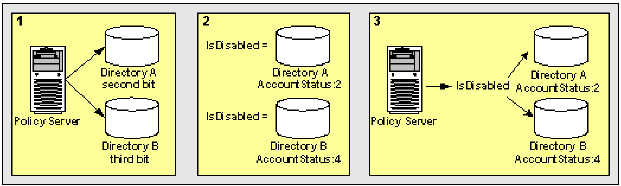
This results in two different views of the same user information.
IsDisabled results in a common view of disabled user accounts. You can reference IsDisabled when defining assertion attributes or NameID attributes that require the account status of users. The system has no concern for the directory-specific schema because the directories are operationally identical.
| Copyright © 2012 CA. All rights reserved. |
|