

CA NSM delivers an architecture consisting of the following three layers:
This layered architecture delivers a powerful, distributed, and versatile management solution to accommodate large-scale, complex, and dynamic environments. Data collected on each node in the enterprise passes from the monitoring layer to the management layer to the WorldView layer, as shown in the following illustration.
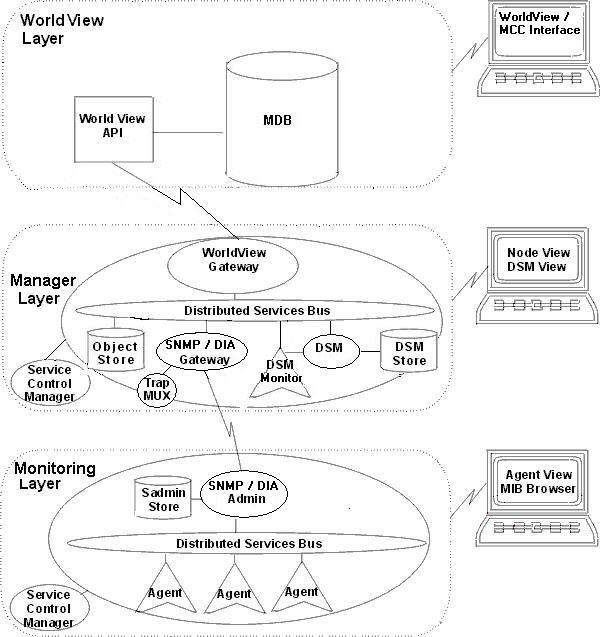
The Monitoring Layer collects data about your enterprise.
An agent is an application that supports network management. An agent typically resides on a managed software node, such as a Windows XP server, and provides information to a management application.
This information is interpreted according to a management protocol that is understood by both managers and agents. CA NSM agents use the following protocols:
User datagram protocol (UDP) of the transmission control protocol/Internet protocol (TCP/IP) suite.
Simple network management protocol (SNMP) designed to run on top of TCP/IP.
Distributed Intelligent Architecture (DIA) designed to run on top of TCP/IP.
Both agent and management applications can view the collection of data items for the managed resource. This collection is defined by the Management Information Base (MIB). Each MIB describes attributes that represent aspects of a managed resource. The network management platform accesses MIB data using SNMP.
You can view the current statistics about monitored resources from various interfaces, such as MIB Browser, Agent View browser, and through the Management Command Center.
Every agent must be associated with at least one DSM. Through configuration, you can determine which machines in your enterprise report to a DSM. Each DSM can communicate with only one MDB, but a single MDB can accept information from multiple DSMs.
|
Copyright © 2010 CA.
All rights reserved.
|
|