

A Contract is a collection of objectives. An objective is either a contractual or operational objective (Metric) or a financial objective (Incentive). The process of Contract Modeling involves taking the entire Contract content that lies within scope of the implementation and converting it into the CA Business Service Insight model.
The following diagrams depict this process.
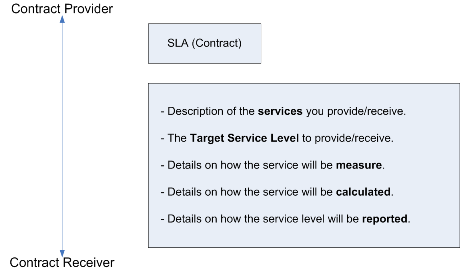
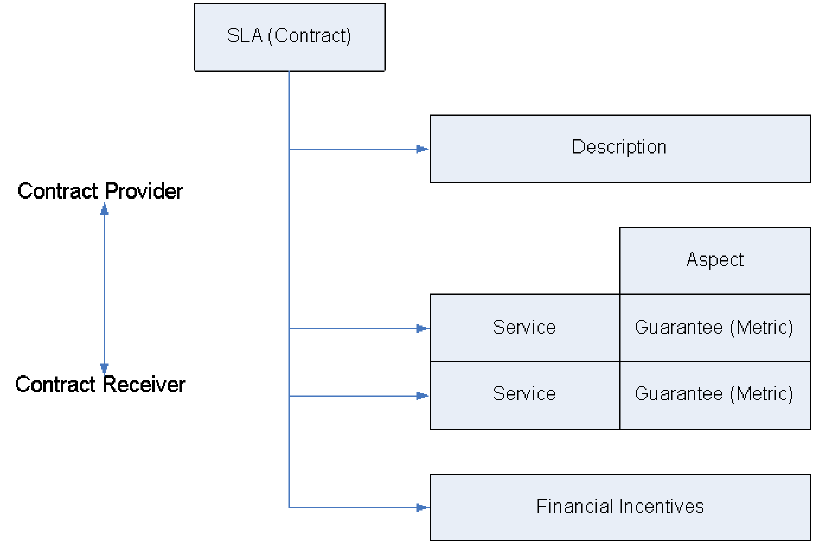
Note: Possible future plans for the system must be taken into account even though only aspects which fall within the implementation scope will be modeled. The scope must include general Contract management requirements of the organization in order to design a broad enough model that encompasses future developments. Doing so minimizes and simplifies any changes that need to be made in the future.
Converting customer contracts into the CA Business Service Insight model is a process whereby the Contract Manager groups the guarantees (Metrics) offered within common bounds into logical groups, common service components, Contract aspects, and so on. This logical grouping allows for very flexible service level management.
The CA Business Service Insight Contract model comprises the entities shown in the following figure:
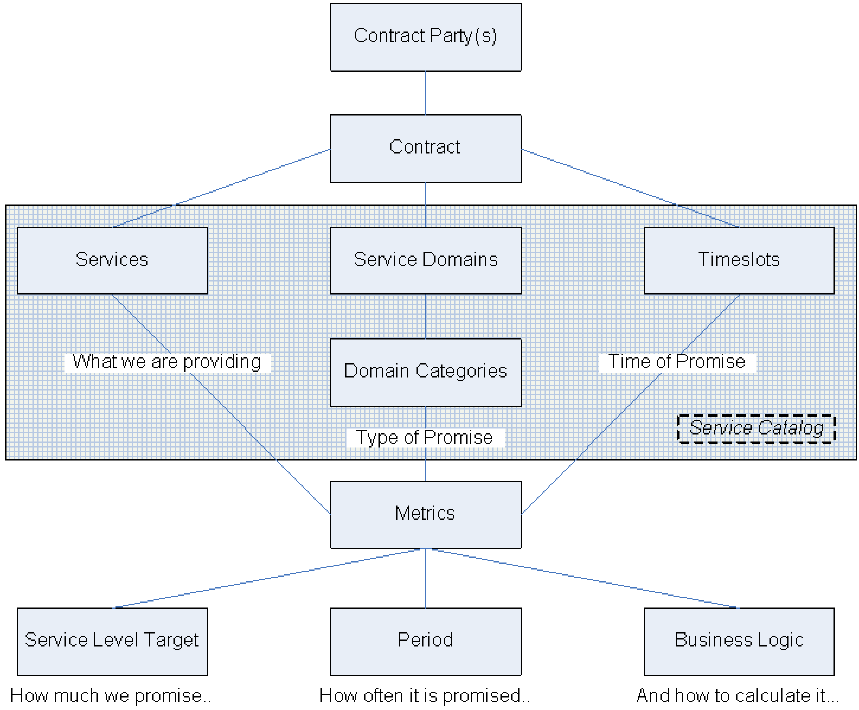
Defines the agreement and collection of Metrics. A contract can be one of three different types depending on the relationship between the Contract Parties involved. It can be either an SLA (Service Level Agreement between the organization and its customers), OLA (Operational Level Agreement between divisions within the organization) or a UC (Underpinning Contract between the organization and its suppliers, where generally the UC is on a service for which the organization is supplying to another customer via an SLA).
Defines the customer of the services provided, and with whom they signed the contract. A single Contract Party can be attached to more then one Contract. Note that within the contract you are able to define the provider and receiver of the services pertaining to that contract.
Defines a single service level objective or guarantee. Each Metric is a request for measurement that produces the actual service level result on which reporting is performed.
A Metric comprises the following items:
A Metric can be one of the following eight types:
|
SLO |
Service Level Objective. |
|
Informational |
Service Level Objective without a target. |
|
KPI |
Key Performance Indicator, used to support different industrial concepts. In Telco KPI=SLO and means customer obligation while in IT it means a technical obligation. |
|
KQI |
Key Quality Indicator, an overall metric to measure aggregated result from different indicators. |
|
Interim |
Interim measurement to use in other metrics. These metric results cannot be reported. |
|
Consumption |
Used by Financial metrics to calculate service/resource consumption. Used in conjunction with Price Item metrics |
|
Incentive |
Financial metric, used for incentive (positive term for penalty) calculations. |
|
Price Item |
Financial metric, used to calculate results based on consumptions. Different prices per period or per number of units. |
Contractual reporting period or period for which the actual calculated service level result is compared with the target. The tracking period in CA Business Service Insight can be defined with a granularity of Hour, Day, Week, Month, Quarter, or Year. For the purposes of root cause analysis, in addition to the tracking period, the metric is also calculated in the other six granularities, but the results for these periods are marked as operational results only.
Note: This is only performed if these calculation granularities are specified for the metric.
Time within the tracking period during which the specific guarantee or obligation is applicable, including exceptional timeslot definitions, such as predicted maintenance windows, standard bank holidays, and so on.
Formula that defines how to evaluate raw data in order to calculate the actual service level value for that aspect of the service, and the specific assumptions the calculator needs to take into account. During the design phase, only the outline of the calculation is identified. It is defined in greater detail during the Configuration phase.
Contractual service level obligation. The target may or may not be mandatory, depending on the type of metric in question. In the case where a target is not defined, the metric provides results for reporting purposes only, and it lacks the ability to be compared with a contractual obligation or guarantee. Targets can be static or dynamic.
Note: To follow some of the concepts presented so far, refer to Appendix B - Case Studies.
Each Metric is related to the following system-wide entities contained within the system template folder:
Describes what is obligated to provide.
Collection of Service Components. A single Service Component may be a part of more than one group. A Service Component Group is an optional entity, if used, can provide a greater flexibility for reporting.
Specific aspect of service components that need to be measured for the purposes of service level monitoring (for example, Performance or Availability).
Specific unit of measurement. This defines the default unit of measurement and whether the target objective is a minimum or a maximum value. Essentially this is the specific dimension of the service domain being measured (that is, % of time available, number of outages, average throughput rate, and so on).
Each of the above entities, as well as their relationships to all service level objectives that are to be monitored in CA Business Service Insight, need to be identified during the Contract modeling stage.
|
Copyright © 2012 CA.
All rights reserved.
|
|