

During the design phase, input and output gathered requirements are translated into the CA Business Service Insight model structure comprising Contracts, Metrics, and Resources. This means transforming real-world data and conceptualizing it so that it fits the CA Business Service Insight framework.
The system design includes the following:
Customer SLAs are interpreted into CA Business Service Insight contracts and service catalog entities (such as the Template Folders) are defined. This is done mainly by the Contract Manager.
Resource data is examined and modeled into the CA Business Service Insight resource model. This is done by the Data Source Expert and Business Logic Expert.
There may be several methods available for either contract or data modeling. However, often there is an optimal practice that not only solves the problem, but also offers more flexibility or productivity, thereby providing a strong framework for further growth.
To assist the Data Source Expert in choosing the most suitable methods, case studies are used with suggested solutions.
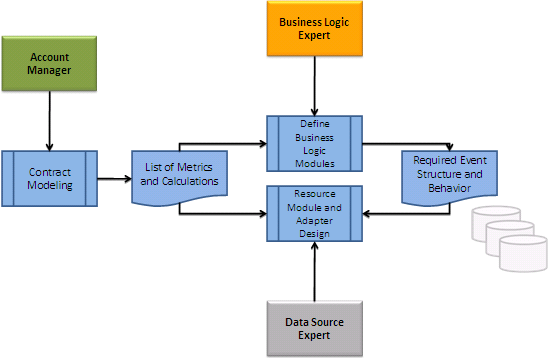
As shown in the previous workflow diagram, as a result of the Contract modeling process, the Contract Manager provides as an output the list of Metrics that should be configured in the system and their calculation outline definition.
Example:
Customer A, CNP System average response time.
The Metrics list is provided as an input for the Business Logic Expert that defines the required event structure and event behavior that allows defining the required calculation script.
The Metrics list and the event structure and behavior requirements are the input for the design of the resource model and the data adapters by the Data Source Expert.
|
Copyright © 2013 CA.
All rights reserved.
|
|