

An increase in the Server Response Time and in the number of Observations is a strong indicator that a performance problem is associated with the server. This conclusion can be reinforced by correlating it with other relative data.
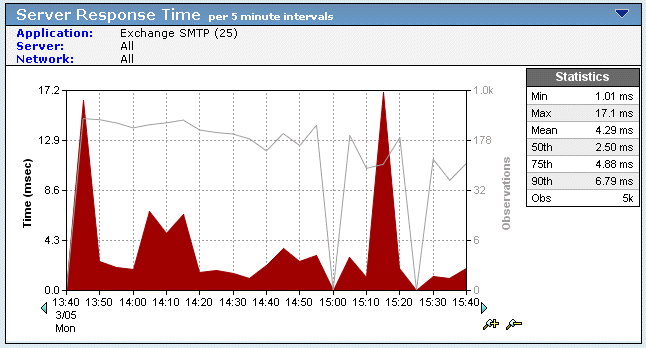
Performance problems associated with a server should be visible across all network sets and aggregations -- both local network sets, including users in the same building as the data center, and remote network sets, including users across WAN connections.
If both the Server Response Time and number of Observations peak at the same point in time as the observed performance issue, review the following data sets for the same point in time:
Check whether the Data Volumes/Rates increased. Servers work harder when writing higher data volumes to the network. Abnormal increases in data volumes that coincide with increases in Server Response Time indicate a server having difficulty keeping up with demand.
Check whether there is a concurrent increase in Server Connection Setup Time that could indicate the OS kernel increased the amount of time that it took to respond to new session requests.
Check whether the number of TCP/IP sessions increased by a significant number, say greater than 10%. Additional TCP sessions and accompanying application requests require more resources from the server and tax its horsepower.
Check whether there was an abnormal increase in the number of Unfulfilled TCP/IP requests. A high increase is a significant indicator the hardware resources of the server are overburdened.
Check whether there is a significant increase in the number of users. Increases in the number of users increases the demand on server resources. The point when a certain number of users cause the Server Response Time to degrade can be interpreted as a future proactive point for upgrading servers or load balancing the application among similarly-configured servers.
Check whether there was an increase in the standard deviation for Server Response Time and/or Percentiles. This could indicate inconsistent and sporadic performance by the server as seen in more "outlying" data points that are at significantly varying distances from the average, and is a strong indicator of server-based issues.
|
Copyright © 2015 CA Technologies.
All rights reserved.
|
|