

In a single-system deployment, all components of CA Risk Authentication and the application which users log in to, are installed on a single system. The database may be on the same system where CA Risk Authentication is installed, or on a different system.
It is possible to use both Java SDKs and Web services in a single-system deployment. The prerequisite software for these components is identical. The simplest way to perform a single-system deployment is to select the Complete Installation option while running the CA Risk Authentication installer.
If you plan to perform a single-system deployment, perform the following steps:
You can use an existing database on a separate system.
Important! Do not use Sample Application in production deployments. You build your own web application by using Sample Application as a code-reference.
Java SDKs
The following diagram illustrates CA Risk Authentication Server and Java SDKs deployed on a single system.
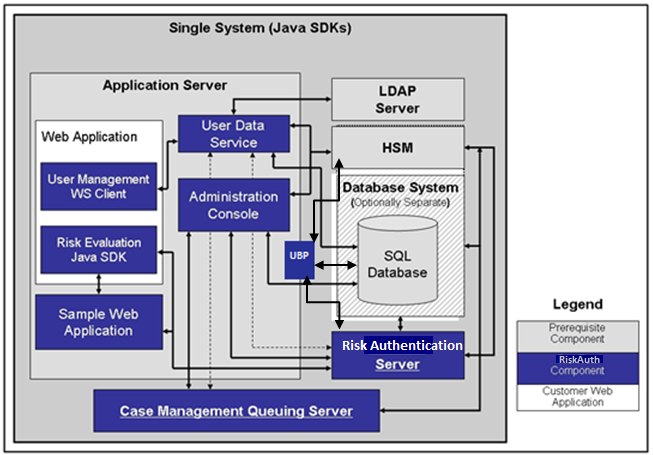
Note: The use of a web server to deliver HTML pages for the application server is optional and is transparent to CA Risk Authentication. In production deployments, this approach is typically used to improve the application server performance and security. For more details, see the documentation on Application Server.
Web Services
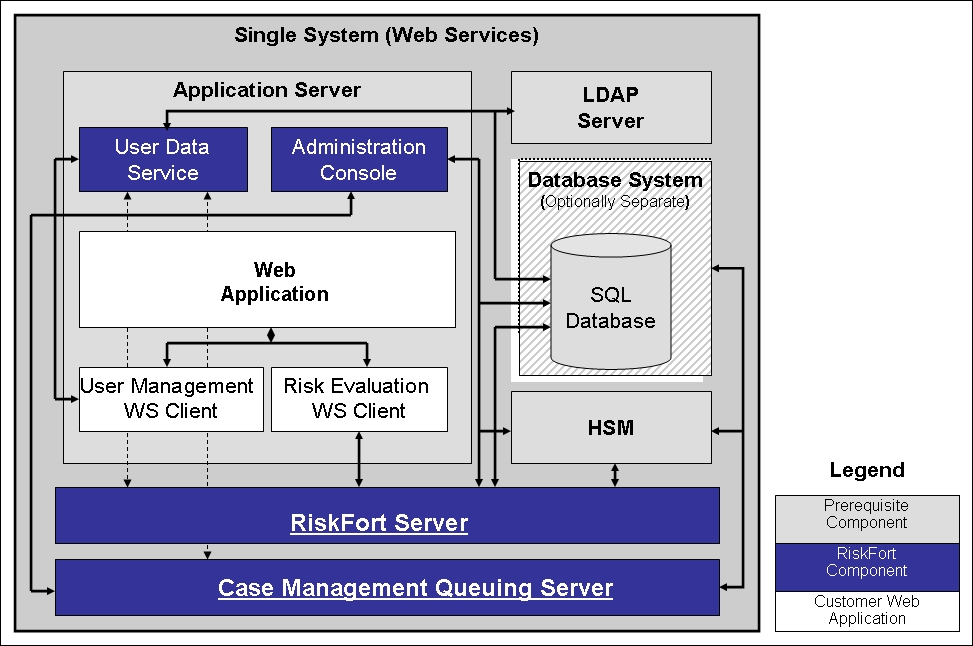
The following figure illustrates CA Risk Authentication Server and Web services on a single system.
Note: Install CA Risk Authentication Server on the target system and generate the requisite client stubs because, all web services are now built into the CA Risk Authentication Server module itself. No further configuration is required.
|
Copyright © 2014 CA Technologies.
All rights reserved.
|
|