

You may have Applications with many groups of interlinked dependencies. You can create dependencies between all the jobs in these groups individually, or you can create a link workload object that waits for the completion of the first group of jobs and then releases the second group of jobs. This approach simplifies the predecessor dependencies and makes it easier to add or delete jobs in each group.
Example: Create a link between Groups of Jobs
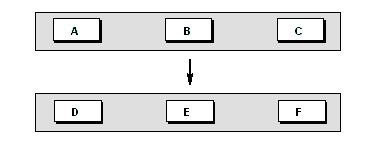
Consider the following Application, which has two groups of three jobs each. The second group of jobs (D, E, and F) cannot run until all jobs in the first group (A, B, and C) complete. The following illustration displays the dependency between the two groups of jobs:
To create this dependency configuration, you must create dependencies from all three jobs in the first group to all three jobs in the second group. The following illustration displays the required dependencies between the two groups:
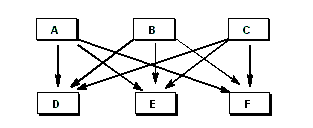
The interlinked dependencies of this Application may be difficult to read and maintain. To simplify this dependency configuration, create a link that represents the completion of the first group of three jobs and releases the second group of three jobs.
The link waits for jobs A, B, and C to complete and then releases jobs D, E, and F. The following illustration represents the dependencies between the jobs using a link:
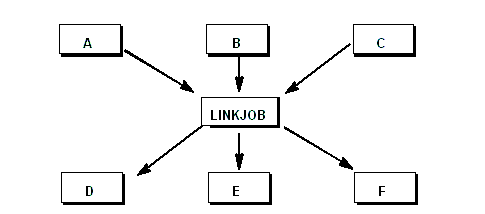
The server automatically completes a link as soon as its dependencies are met. After the jobs in the first group (A, B, and C) complete, the server marks the link complete and releases the second group of jobs (D, E, and F).
|
Copyright © 2014 CA Technologies.
All rights reserved.
|
|