

A payload producing job is a job that produces binary output that is persisted as a serialized Java object. The serialized Java object is stored as a file on the agent computer.
The following job types are payload producing jobs:
Note: The appservices.jms.subscribe.persist parameter must be set to true in the agent's agentparm.txt file for JMS Subscribe jobs to be payload producing jobs.
The serialized Java object produced by a payload producing job is stored on the agent computer in the spool directory, using the job name and a numeric suffix as the file name, or in a destination file you specify.
A payload consuming job is a job that uses the output from a payload producing job as a parameter's input value.
The following job types are payload consuming jobs:
A URI (uniform resource identifier) stores the location of the binary output produced by a payload producing job. From your scheduling manager, you can retrieve the value of the URI from a payload producing job and pass the URI as input to a payload consuming job. When the payload consuming job runs, it takes the binary output referenced by the URI as an input parameter.
Note: For more information about retrieving the URI of a payload producing job, see the documentation for your scheduling manager.
Example: Pass Payload Producing Job Output as Input to Another Job
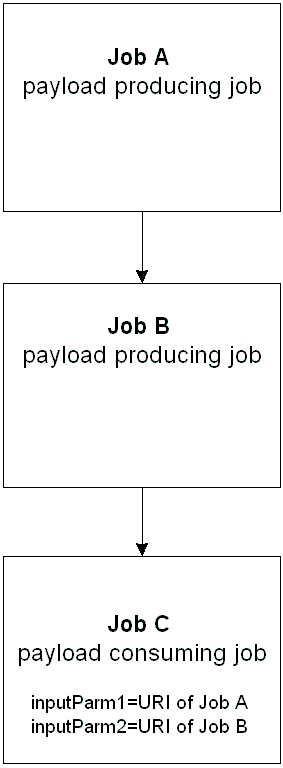
The following diagram shows the relationship between three jobs in a job flow. Job A and Job B are payload producing jobs that produce binary output. Job C is a payload consuming job that takes two parameters, inputParm1 and inputParm2. Job C uses the output from Job A and Job B as input values. In the definition of Job C, the value of inputParm1 is specified as the URI of Job A and the value of inputParm2 is specified as the URI of Job B.
|
Copyright © 2013 CA Technologies.
All rights reserved.
|
|