

A logical operator uses the logically-combined result of two or more objects in the job flow to control subsequent processing. Objects are connected to logical operators using dependency links. You must define the property of the dependency link, such as the result of a job run (success, failure, and so on), from objects that precede the logical operator. The dependency link from a logical operator to the next object in the job flow has no properties to define; the operator itself controls subsequent processing.
The available logical operators are:
 AND
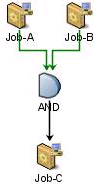
ANDSubsequent processing occurs as the result of the logical AND of two or more preceding objects. For example, if you want Job-C to run when Job-A and Job-B both complete successfully, the dependency statement for Job-C is: s(Job-A) & s(Job-B).
The following diagram shows how this dependency statement appears in Application Editor:
 OR
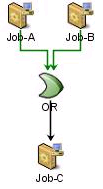
ORSubsequent processing occurs as the result of the logical OR of two or more preceding objects. For example, if you want Job-C to run when either Job-A or Job-B completes successfully, the dependency statement for Job-C is: s(Job-A) | s(Job-B).
The following diagram shows how this dependency statement appears in Application Editor:
|
Copyright © 2013 CA.
All rights reserved.
|
|