

Scratch processing in a P2P configuration requires a Virtual Volume to pass new edits to validate the ownership of the Virtual Volume. Remote Scratch volser selection is performed by the Remote System utilizing a round-robin selection process. As Virtual Volumes are created, a unique signature of the remote drives configuration and the remote system configurations are placed into the Virtual Volume record. The remote systems will not allow scratch processing for Virtual Volumes that do not match these signatures. The ownership of the Virtual Volume remains with the remote drives site until the Virtual Volume is scratched by the local system.
During scratch processing on the local site, the signatures of the Virtual Volumes are checked. When the signature passes edit checks the Virtual Volume is immediately scratched locally and a list of candidate volumes is queued for transmission for scratch processing by the remote system. Once the remote site receives the list it also validates the signatures and scratches the Virtual Volumes.
The Scratch Synchronization Job must be executed on a system that has a CA Vtape Subsystem running with a P2P connection to the remote CA Vtape Complex that owns the VOLSERs to be scratched. The SVTS parameter in the VVESYNC step of that job must be set to the subsystem Id of the CA Vtape Subsystem with the P2P connection.
Example scratch processing in a P2P configuration
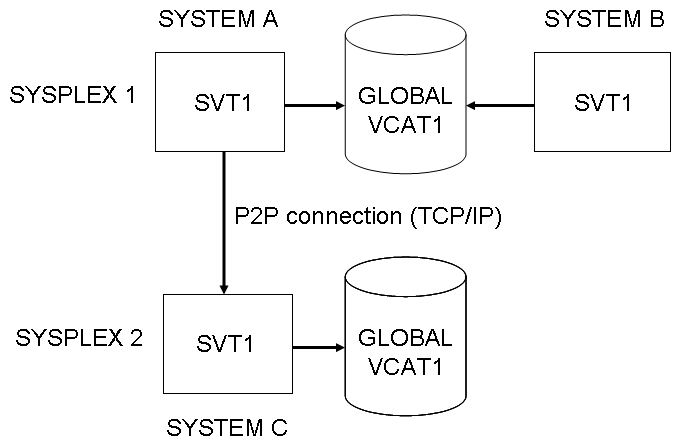
In the above configuration, the Scratch Synchronization Job must be run on system A with SVTS=SVT1 to scratch the Virtual VOLSERs written on system A and transmitted to system C since both Global VCATs have entries for those VOLSERs. If the Scratch Synchronization Job is run on system B, SVT1 cannot communicate the scratch to system C.
The Scratch Synchronization Job must also be run on system C with SVTS=SVT1 if Virtual Volumes were written on system C regardless of whether or not those Virtuals were transmitted to SVT1 on system A.
|
Copyright © 2013 CA Technologies.
All rights reserved.
|
|