

This figure illustrates how qualified data set names can relate directly to the organization chart:
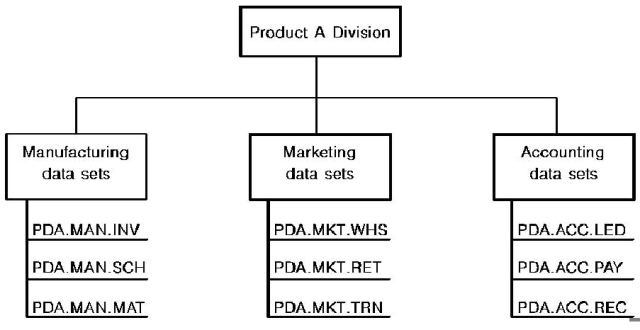
When you use levels of qualifiers to define data set names, you create three different methods to indicate to CA TLMS which data sets are to be included in the action being requested:
When CA TLMS searches for data set names that match the data set definition, it matches as many characters as it can. Therefore, a fully qualified DSN takes precedence over a partially qualified DSN. A partially qualified DSN with more qualifiers takes precedence over a partially qualified DSN with fewer qualifiers.
The following chart illustrates examples of those data sets that would be included in each type of definition. (The order of the examples corresponds to the numbered list in Qualifying Data Set Names.)
|
Definition |
Data Sets Included |
Data Sets Not Included |
|---|---|---|
|
PDA.MAN.INV.YREND.Y1992 |
PDA.MAN.INV.YREND.Y1992 |
PDA.INV.YREND.Y1992A |
|
PDA.MAN.INV- |
PDA.MAN.INV.YREND.Y1992 PDA.MAN.INV.BLD PDA.MAN.INVENTORY |
PDA.MAN.SCH.YREND.Y1992 |
|
PDA.MAN.INV- |
PDA.MAN.INV.YREND.Y1992 PDA.MAN.INV.DMP PDA.MAN.INV.BLD |
PDA.MAN.INVENTORY PDA.MAN.INV |
At this point, it is only important to understand that you can use data set naming standards to group data sets that have the same retention criteria. This can later reduce the number of definitions you have to code.
|
Copyright © 2014 CA.
All rights reserved.
|
|