

The Volume Master File is a BDAM file which can be accessed through programs TLMSVMRW and TLMSVMIO. The file contains multiple record types, with related records chained together. Volume records can be accessed by an internal index structure.
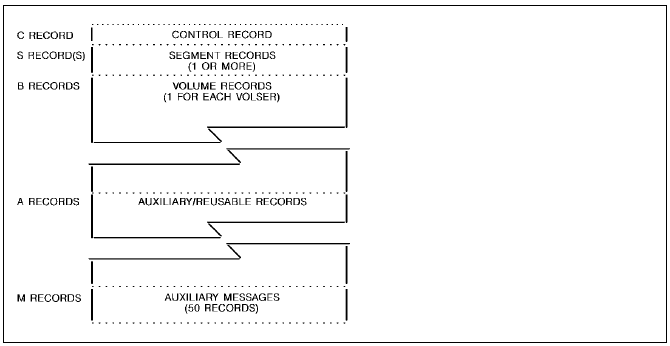
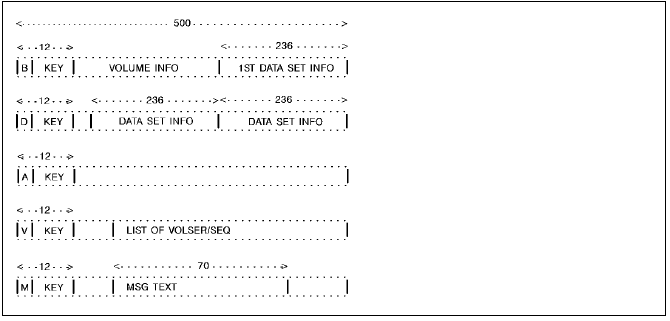
The Volume Master File consists of a 500-byte record for each volume in the tape library. The name, number, status and characteristics of each data set in the tape library are maintained in this file. The following records comprise the VMF:
The control record (type C) is the first in the file. It contains such information as the company name, Auxiliary control statement, Message control statement (YES/NO), Scratch control statement (YES/NO), information about the CPUs which access it, and pointers to other areas of the VMF.
One or more segment records (type S) follow the control record. Each of these define multiple volume serial number ranges of the VMF. Each definition contains the first VOLSER, the number of VOLSERs, and a relative block pointer to the first volume base record (type B) for the range. Segment records are used to calculate the relative block of a volume serial number. There is at least one segment record, and there can be as many as necessary to define all base record segments.
The volume base records (type B) follow the segment records. There is one base record for each volume defined in the VMF. This record contains information about the VOLSER and the first data set residing on it. Each record also contains a pointer to the next and last data set records (type D) which exist on this volume. If the volume is the first of a chain, it contains information to point to the other volumes in the chain. A base record can hold information for the first six volumes in a multivolume file. After this, a multivolume record is needed.
These records are chained together and pointed to by an entry in the control record. When CA TLMS needs to write a multi-data set record (type D) or a multivolume record (type V), an auxiliary record is used. It is first removed from the auxiliary chain or from the reuse chain, and then rewritten as a type D or V, and then re-chained to the appropriate volume record. If a type D or type V record is to be deleted, it is rewritten as an auxiliary record and placed on the reuse chain.
Auxiliary message records are optional. If they are requested (MSG=YES|NO is specified when initializing VMF), they exist as the last 50 records in the VMF.
|
Copyright © 2014 CA.
All rights reserved.
|
|