

The Unified Service Model (USM) is the semantic schema that is used as the CA Catalyst and CA SOI infrastructure. USM was developed to abstract and integrate information across many management products and domains and provide a single point for data federation, interoperability, and access to management data across an enterprise.
The USM schema defines the internal format for all CA Catalyst data, which is transmitted for display to CA SOI. Connectors transform all data collected from domain managers to the USM format before sending the data through CA Catalyst to CA SOI.
In IT management, specific domains exist such as networks, systems, fault, or security management systems and also specific standards exist for the domains. No mediating set of abstractions can discern the core concepts from the details and enable the merging of the specific domain semantics and data. USM addresses the mediation by defining logical, coherent, high-level, and common representations of general resource types, their data, and operations.
Specific data properties for USM types enable the following:
Data in different product-specific formats normalize to a single, consistent format that is correlated, reconciled, and accessed by users, applications, and reports.
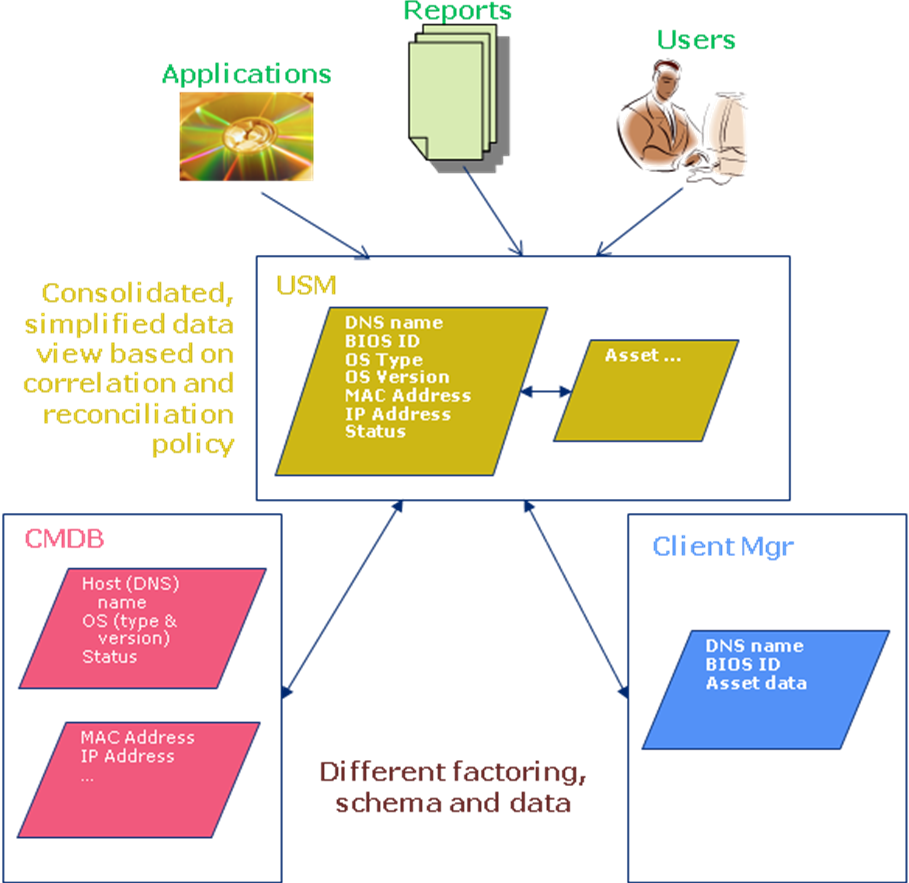
CA Catalyst is the integration and application platform that implements the USM schema, and CA SOI displays CA Catalyst data in USM format.
|
Copyright © 2013 CA.
All rights reserved.
|
|