

Configuration for Tenant Deployment
CA Directory is configured to use distinct multi-write groups at each site, with bi-directional asynchronous replication between sites. The CA Directory configuration is generated by CA CloudMinder at both the primary site and DR site during tenant deployment, which is covered in a subsection of this chapter.
Two data DSAs are deployed for each tenant, a User DSA and a Provisioning DSA. For each of these two logical data DSAs, two instances are deployed at the primary site and one or two instances at the DR site. One data DSA at each site is the master data DSA that is targeted for write operations from the DXrouters. The other non-master DSA is responsible for asynchronous replication to the other site.
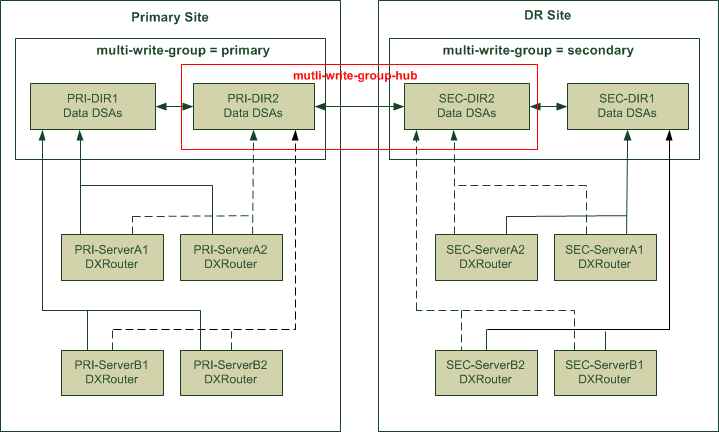
The following diagram shows a typical dual-site deployment from the perspective of CA Directory configuration. For each site, the directory servers appear at the top of diagram. The other server systems, which deploy Dxrouters, appear below the directory servers. A multi-write-group is defined at the directory servers and each DXrouter indicates a write-precedence for the DIR1 directory server (where the master DSAs reside). Replication between sites is enabled by defining the multi-write-group-hub on the DIR2 directory servers at each site.
Response to DSA Failure
In the event of a master DSA failure, the DXrouters switch traffic to the non-master DSA automatically. This allows the primary site to continue operation without interruption. In the event of a non-master DSA failure, data replication from the primary site to the secondary site will stop. This does not impact primary site operation. However, if the non-master DSA cannot be restored within a reasonable time period, consider reconfiguring the master DSA as the multi-write-group hub. You remove the CA Directory server hosting the non-master DSAs from the hosting container configuration. You can restore this server later when the failure is resolved.
|
Copyright © 2014 CA Technologies.
All rights reserved.
|
|