

|
|
|
The chain authentication model is appropriate for solutions that require XML messages to flow between multiple web services without further intervention from the requesting web service consumer.
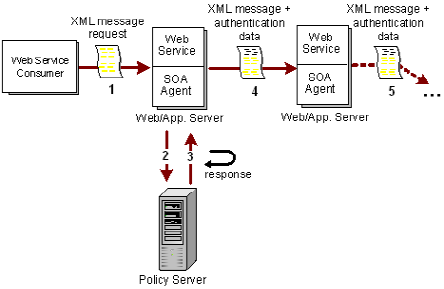
In the chain authentication service model, a single web service is responsible for authenticating all incoming web service requests. This authentication service verifies a web service consumer’s identity, and then adds authentication data in the form of WS‑Security headers or a SAML Session Ticket assertion to the XML message. It then passes the document to downstream web services for processing.
The following illustration shows the flow of data in the chain authentication model.
The most appropriate authentication schemes for initial authentication of requests from the web service consumer by the authentication web service in the chain authentication model are as follows:
The authorizing policy for the authentication web service should trigger one of the following responses:
These responses instruct the SOA Agent to add WS‑Security headers or SAML Session Ticket assertions (as appropriate) to the XML request passed to the next downstream web service in the chain, which should then be protected using the corresponding authentication scheme:
Note: SOA Agents can be configured to accept information from a SiteMinder session (SMSESSION) cookie sent in the HTTP header of a request as a means of authenticating a client and always add such cookies to request headers upon successful authentication and authorization. Therefore CA SiteMinder session cookies can therefore be used to implement chain authentication within an all CASiteMinder/SOA Security Manager environment.
| Copyright © 2011 CA. All rights reserved. | Email CA Technologies about this topic |