Previous Topic: The Web ServicesNext Topic: Terms Used in this Guide


Processing Data with Web Services

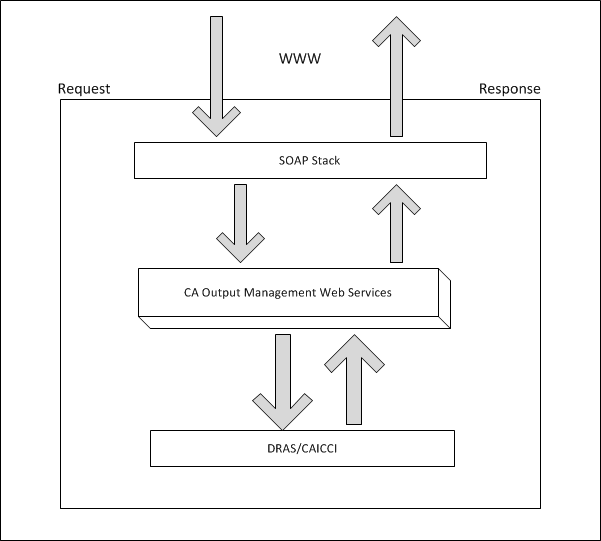
The following diagram is an overview of the OM Web Services that shows how data flows into the Web Service, is processed and then returned:
OMWS_Developer guide_Chapter 2

  1. The SOAP receives the request using HTTP or HTTPS.
  2. The SOAP stack receives the data and invokes one of the OM Web Services.
  3. The OM Web Services process the request. These Web Service requests send requests to the Host Output Management product to retrieve data using the Distributed Repository Access System (DRAS) and CA International Common Communications Interface (CAICCI) components.
  4. Data that is retrieved by the OM Web Services request is formatted for return to the client application.
  5. The CA OM Web Service returns to the SOAP stack.
  6. The SOAP stack transforms the data into SOAP syntax for the transmission back to the client application and transmits the data.

Note: For each Web Service API call, an individual DRAS connection is created. A DRAS connection will be established to execute each API call and be disconnected after the call, which can incur a significant performance overhead.

To reduce the connection cost, a local cache method is recommended to store the returned report lists and report data in the local memory of the Web Service client applications. Depending on the timeliness of your application data, you can construct this cache to be refreshed periodically.

Note: For more information, see Terms Used in this Guide.