

The CA Network Flow Analysis Administration page lets you review, administer, and customize the network data view. When you access this page, the System Status displays and uses the following status icons:
Click a red exclamation mark to view the associated error report. The error report includes the IP address, the type of component, and more information about the error. No error messages are displayed for a green check mark.
Notes:
Administration Landing Page for an NFA Console That Is Registered with CA Performance Center
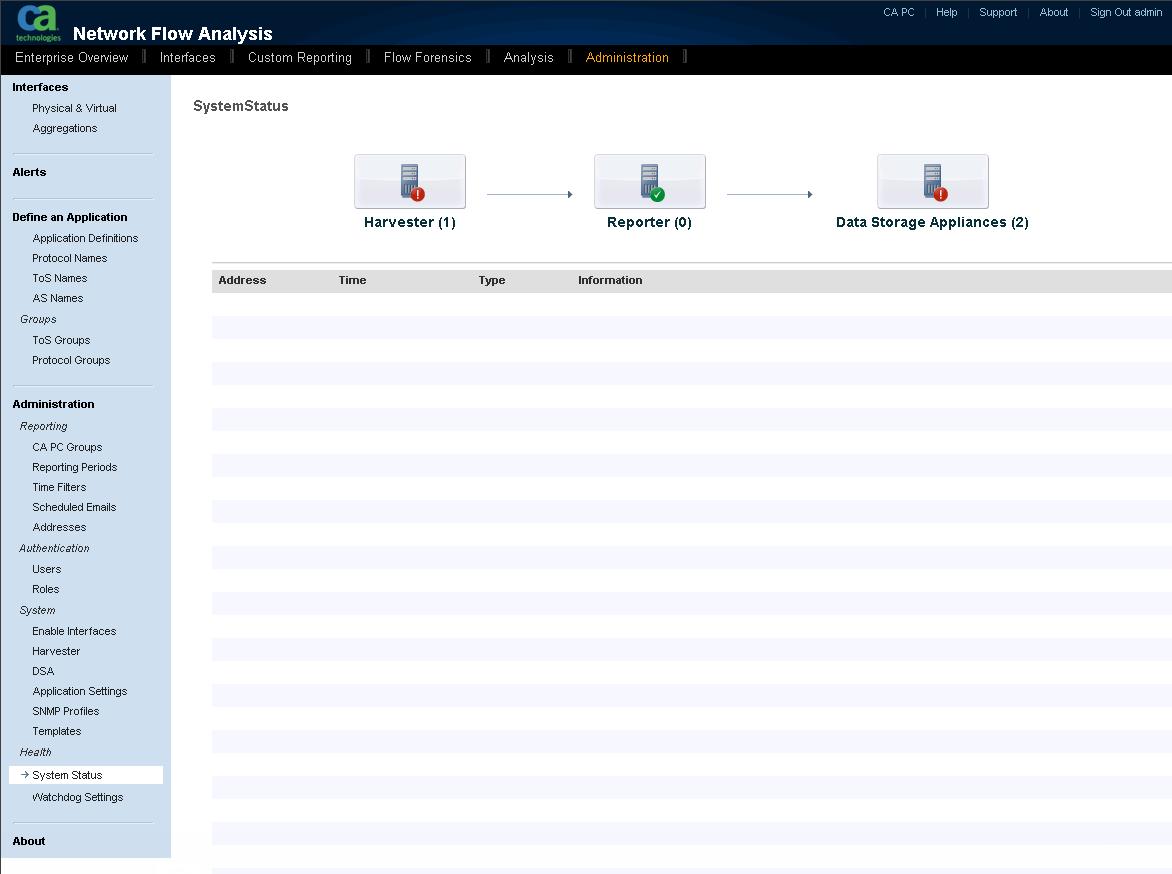
A menu of administrative options is on the left side of the page. The following list describes the page that opens for each option and its function.
View the status of the interfaces on the Active Interfaces page, which opens in List/Edit mode. You can also edit, delete, or merge interfaces or create a custom virtual interface (CVI).
Aggregate interfaces on the Aggregation Interfaces page so you can view the interfaces as a unified group.
Open the Trap Configuration page and review, add, edit, and delete traps.
Open the Application Definitions page and define rules for application mapping, port priorities, or Reserved Seating.
Open the Protocol Configuration page and edit a protocol name and description in the context of a particular tenant and domain.
Open the ToS Configuration page and edit a ToS label (description) in the context of a particular tenant and domain. In addition, add, remove, or edit groups of ToS values.
Open the AS Names page and search, edit, or reset AS names in the context of a particular tenant and domain.
Open the ToS Group Configuration page and review, add, delete, or edit ToS groups.
Open the Protocol Group Configuration page and review, add, delete, or edit protocol groups.
Open the Manage Groups page in CA Performance Center or CA NetQoS Performance Center. Review system groups and add, remove, or edit custom groups and site groups. This option is enabled only if CA Network Flow Analysis is registered as a data source for CA Performance Center or CA NetQoS Performance Center.
Open the Reporting Periods Configuration page. Add, edit, and delete the reporting periods that are available on Interface report pages as time frames for the period of data collection.
View, add, edit, and delete time filters on the Time Filter Configuration page.
Open the Scheduled Emails page and review the reports that are scheduled for email delivery. You can change the destination address, Subject line, accompanying message text, and schedule options.
Open the Address-Hostname Configuration page and specify a mask and options for resolving DNS names in the context of a particular tenant and domain. List, edit, delete, and expire addresses. By expiring addresses, you schedule them to be refreshed.
Open the Manage Users page in CA Performance Center or the User List page in CA NetQoS Performance Center. Review the existing user accounts and their settings. Add, remove, and edit user accounts. This option is enabled only if CA Network Flow Analysis is registered as a data source for CA Performance Center or CA NetQoS Performance Center.
Open the Manage Roles page in CA Performance Center or the Roles List page in CA NetQoS Performance Center. Review the existing role names, available menus, and capabilities. Add, delete, and edit roles. This option is enabled only if CA Network Flow Analysis is registered as a data source for CA Performance Center or CA NetQoS Performance Center.
View the status of routers on the Available Interfaces page. View the list and status of the interfaces for each router. Enable, disable, or delete interfaces.
Open the Harvester page and view, add, edit, and delete the Harvesters that send data to the NFA console.
 DSA
DSAThree-tier architecture deployments only: Add a DSA to the configuration or edit the DSA IP address. In a three-tier architecture deployment, one or more DSAs store the 15-minute (historical) data for reports.
Edit a wide range of application settings on the Application Settings page.
Manage SNMP profiles on the Manage SNMP Profiles page in CA Performance Center or the SNMP Profile List in CA NetQoS Performance Center. This option is enabled only if CA Network Flow Analysis is registered as a data source for CA Performance Center or CA NetQoS Performance Center.
Open the Interface Templates page and view, add, edit, and delete the templates that determine the way interfaces are displayed.
View the overall status of the CA Network Flow Analysis components on the System Status page. Display a list of the problem reports for each component.
Data Storage Appliances (DSAs) status is useful only for three-tier architecture deployments. DSAs are not included in two-tier deployments. In a two-tier deployment, the DSA status always shows a green system status icon.
View and edit Watchdog configuration settings on the Watchdog Settings page.
View the product version number, installation date, and documentation on the Version Information page.
|
Copyright © 2013 CA.
All rights reserved.
|
|