

|
|
|
During implementation, you created a database based on the supplied data model.
ReportCenter accesses the data in this database by using a JDBC connection. You can also use any ODBC or native database product to access the data from outside of ReportCenter.
The same data model is used for DB2 and CA Datacom/AD.
The data model uses a classic data warehousing snowflake schema with non-application specific design including large, central fact tables, and a generic resource dimension table.
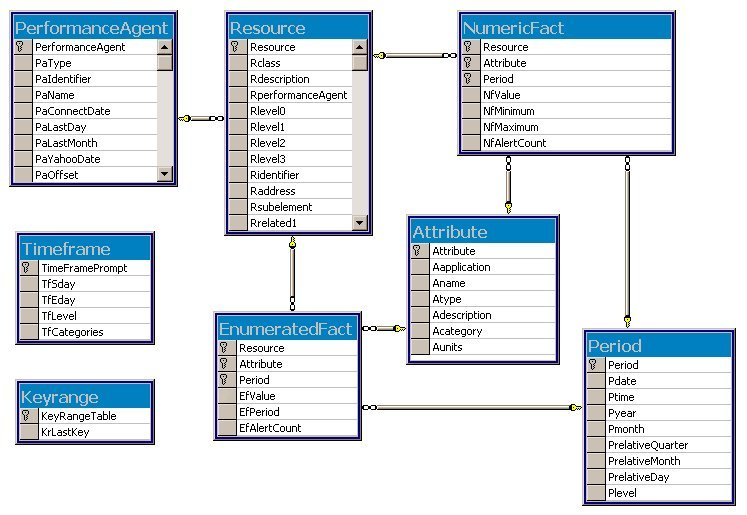
The data model has the following tables:
Stores the details of performance agents sending data to the data warehouse. There is one row per agent.
Stores the details of an individual monitored resource. The column usage varies with the resource class. There is one row per monitored resource.
Stores numeric fact data for counter and gauge attributes.
Provides DBMS-independent time frame handling. Used as an internal worktable.
Contains one row for every reported or monitored attribute.
Controls the generation of dimension table keys. Used as an internal worktable.
Stores character fact data for enumerated attributes such as NETSTATUS and PUSTATUS.
Used in conjunction with the Timeframe table to provide data retrieval based on an DBMS-independent time frame.
The database tables and their relationships are shown in the following diagram. A fact table always joins to the Attribute, Period, and Resource tables, as indicated by the keyed connections. The Resource table further joins to the PerformanceAgent table.
| Copyright © 2012 CA. All rights reserved. |
|