

|
|
|
Basic SNA resource management does not provide a business view of the services you are providing. To carry network management further, you need to group resources into the services they provide.
When you start your region for the first time, you can immediately monitor the SNA resources using the SNA network summary display. By using the supplied default SNA resource models, the region also maintains the desired state of the resources. This desired state is determined by the initial status of a resource in the VTAM domain.
However, you need to define those resources to the knowledge base if you want to provide the following:
Instead of using the initial status of SNA resources in the VTAM domain as the desired state, you may want to manage their desired state in more detail. For example, you may want a resource to be active over certain periods of time and to be inactive over other periods of time. You may also want to include the resource in a service.
If you want to do the above, you must define the affected resources to the knowledge base. To define the resources, define a system image and then define the resources to that image.
You define SNA resources in SNA groups, each of which can contain one or more resources. You specify the availability requirements of those groups, and the contained resources inherit that availability.
If you want to include the management of non-SNA resources as part of network operations, you can define them as USRCLS class resources.
Note: For information about how to define USRCLS class resources, see the Reference Guide.
An SNA group lets you group SNA resources in the local VTAM domain. Where your business function uses resources from multiple VTAM domains, you can include the required SNA groups in the different domains in a single service.
A typical service includes different classes of resources. It may require SNA resources, but it may also require other classes of resources such as system resources, CICS resources, or IMS resources. You can define these other classes of resources if you have the products that support them.
To run your network operations from a service-driven perspective, group related SNA groups and resources in services and specify the availability requirements of those services. The services then ensure the availability of its members.
Defined services can be monitored. You can tell whether a service is healthy at a glance. If an operational problem occurs, you can display the status of the resources to determine which resources are causing the problem.
Important! You can define and manage services from focal point regions only. Services are not visible in subordinate regions, but you can include resources managed by a subordinate region in a service.
Example: SNA Network with Groups
The following diagram shows an example of an SNA network with SNA groups.
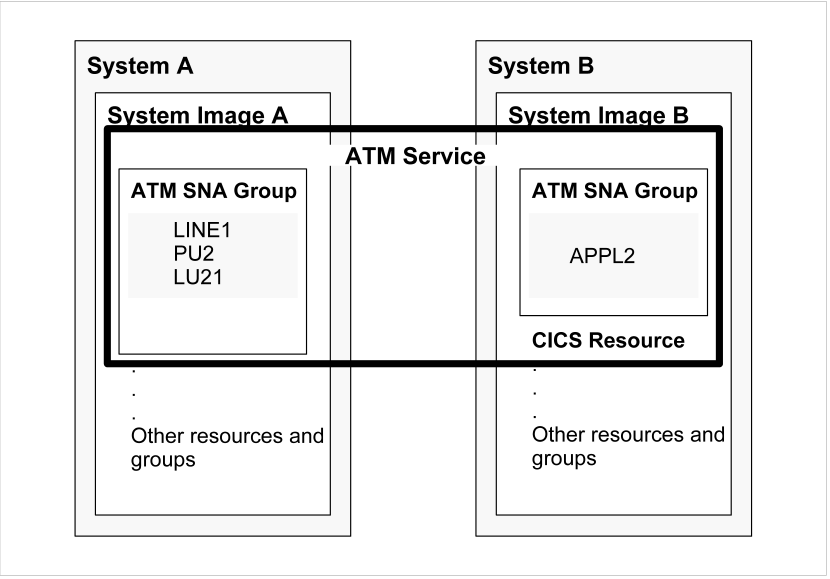
In the network, the CICS application associated with the APPL2 node and the automatic teller machine (ATM) provide a branch service. You want to monitor the health of this service without monitoring the individual resources that make up that service. To provide this function, you need to define a ServiceView service.
Note: To define a ServiceView service, you must have both CA NetMaster NA and CA SOLVE:Operations Automation.
Using this example, a typical service definition task might proceed as follows:
The following diagram shows an example of the defined service.
| Copyright © 2012 CA. All rights reserved. |
|