

The Generic Executor is a reusable entity that is the foundation of CA Mediation Manager components. When a server starts, it is mandatory that at least one Generic Executor component exists and is started.
By default, the LocalConfig-ge.xml file contains the User ID of the CAMM_USER (the user used to install CA Mediation Manager) and the TCP Port (the default port is 29560).

Even though this information is hidden by the installation package, it is important to understand how it works.
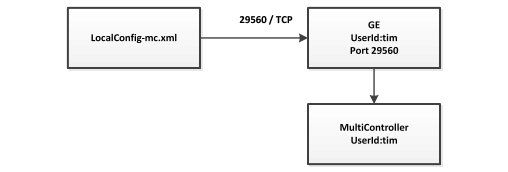
If you require a MultiController to run on this server, you need a LocalConfig-mc.xml configuration file for the MultiController and the TCP port for the Generic Executor.
The following diagram illustrates how the LocalConfig-mc.xml file is sent to the Generic Executor on TCP port 29560, and then the Generic Executor starts a new process for the MultiController:
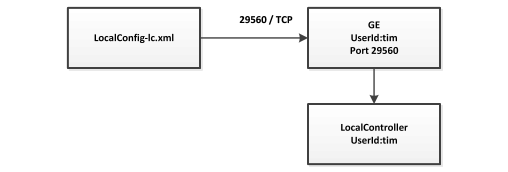
If a LocalController needs to run on this server, only a LocalConfig-lc.xml configuration file for the LocalController and the TCP port for the Generic Executor are required.
The following diagram illustrates how the LocalConfig-lc.xml file is sent to the Generic Executor on TCP port 29560, and that the Generic Executor starts a new process for the LocalController:
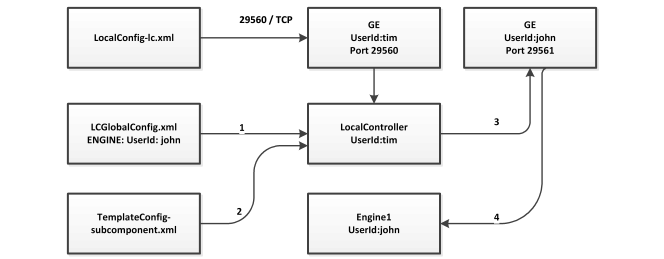
When the LocalController starts, it reads the LCGlobalConfig.xml file from its repository. This file contains the subcomponents that you must start, and the user ID to use for executing these subcomponents.
If an Engine is required to run on this server, the LocalController uses the LCGlobalConfig.xml file to determine which user ID it needs to run as. In the LocalController directory, the LocalController looks up the ExecutorMap.xml file. This action allows the LocalController to locate a Generic Executor that is running as the required user ID. The TemplateConfig-subcomponent.xml file is then combined with the specific configuration from the LCGlobalConfig.xml file. The combination is sent the TCP port of the Generic Executor.
|
Copyright © 2013 CA.
All rights reserved.
|
|