

This section provides a control file tuning example, using a two-system MIMplex. Both SYSA and SYSB are running MODE=DEMAND, CYCLE=1, INTERVAL=1. The MIMplex is using the DASDONLY communication method with the control file on a shared 3390 DASD device. The key fields from the DISPLAY IO command are shown in the following illustration:
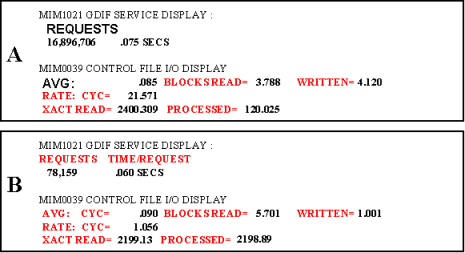
The preceding data can be analyzed as follows: SYSA appears to be a workload-intense production system, while SYSB seems to be a test system as it has little activity. CA MIM is performing control file cycles at a rate of roughly 22 times per second on SYSA, and only one time per second on SYSB. Remember that when in DEMAND mode, control file cycles are driven primarily by CA MIA workload or a timer expiration. Because the number of requests on SYSA is high, it is a good assumption that CA MIM control file cycles are being driven by the workload. In addition, because the number of requests on SYSB is low, CA MIM control file cycles are being driven only by the timer expiration.
This MIMplex appears to be poorly tuned because of the following facts:
In short, the disproportionate control file cycle rates by the CA MIM address spaces are degrading the service times.
This analysis shows that CA MIM on SYSB needs to be performing control file cycles more often, to keep pace with the SYSA control file cycle rate. The correct approach is to issue SETOPTION INTERVAL=.1 on SYSB as this forces CA MIM on SYSB to perform control file cycles at a rate of ten times per second, instead of one time per second. Then issue DISPLAY IO=RESET on both SYSA and SYSB. After 24 hours, issue DISPLAY IO command again on both systems and analyze the data.
You can see:
If further adjustments are warranted, then you might further reduce the INTERVAL on SYSB to .08 (13 accesses per second), reset the DISPLAY commands, and analyze the statistics again after 24 hours.
Once you have found the desired setting, make a permanent update to the MIMCMNDS file so that CA MIM on SYSB has those values in effect at startup. You can add the following statements to the MIMCMNDS file:
IFSYS SYSB
   SETOPTION INTERVAL=.08
ENDIF
In summary, the control file analysis phase is to be performed on all systems in the MIMplex. Based on this analysis, you typically alter the control fine cycle rates on only a small subset of the systems in the MIMplex. Once you have dynamically altered the control file cycle characteristics on a few systems, and are satisfied with the results, update the CA MIM parameter files to have those values in effect at CA MIM start-up.
|
Copyright © 2014 CA.
All rights reserved.
|
|