

The CTCPATH statement identifies the CTC device addresses used to transport the VCF from the master system to the client systems. As of Version 12.0, the CTCPATH statements are valid for all communication methods. Activating COMPATLEVEL=12.0 lets other communication methods use CTCPATH statements.
Conceptually, a CTC device connects an I/O address on one processor to an I/O address on another processor. VCF data that is sent from one side is received on the other side, so every transmission consists of two operations: an outbound write operation from one side, and an inbound read operation on the other side. Data may be transmitted in either direction over a CTC path, but it travels in only one direction at any one moment.
The following information describes how you implement the CTCPATH statement:
During the initialization, the defined device addresses are allocated and made available for use exclusively by CA MIM.
The following information describes how you implement the CTCPATH command:
The CTCPATH statement has the following parameters:
The ADDRESS parameter defines the CTC device addresses used to communicate in an outbound fashion from the system indicated in the FROMSYSTEM parameter. At least one primary address must be specified. The alternate addresses are used in recovery situations.
(Optional) Identifies the originating system for the path. This system sends the VCF in an outbound fashion on this path.
Note: FROMSYSTEM is an optional parameter that defaults to the local system.
(Optional) Identifies the destination system for the path. This system receives the VCF in an inbound fashion on this path.
Note: TOSYSTEM is an optional parameter. Omitting TOSYSTEM causes CA MIM to discover connections as the initial communication completes.
Examples
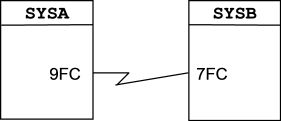
CTCPATH FROMSYSTEM=SYSA ADDRESS=9FC TOSYSTEM=SYSB
CTCPATH FROMSYSTEM=SYSB ADDRESS=7FC TOSYSTEM=SYSA
You would place the preceding CTCPATH statements in the MIMINIT member to represent this configuration.
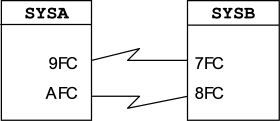
CTCPATH FROMSYSTEM=SYSA ADDRESS=(9FC,AFC) TOSYSTEM=SYSB
CTCPATH FROMSYSTEM=SYSB ADDRESS=(7FC,8FC) TOSYSTEM=SYSA
You would place the previous CTCPATH statements in the MIMINIT member to represent this configuration.
In this example, 9FC/7FC is the primary path, and AFC/8FC is the alternate path. The alternate path is used only when a problem is detected with the primary path. The alternate paths do not provide any performance advantages in terms of load sharing. They are for backup purposes only. Up to 15 alternate paths can be defined between any two systems. The total number of required CTCPATH statements depends on the number of defined systems in the MIMplex and whether the configuration is symmetrical or asymmetrical. We recommend symmetrical configurations because full redundancy provides the best recovery options. Master system recoverability is important in CTCONLY environments.
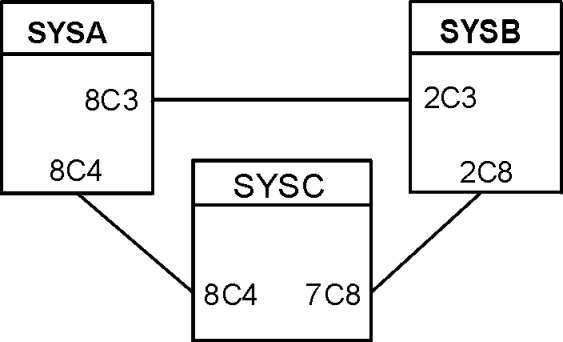
CTCPATH FROMSYSTEM=SYSA ADDRESS=8C3 TOSYSTEM=SYSB
CTCPATH FROMSYSTEM=SYSB ADDRESS=2C3 TOSYSTEM=SYSA
CTCPATH FROMSYSTEM=SYSB ADDRESS=2C8 TOSYSTEM=SYSC
CTCPATH FROMSYSTEM=SYSC ADDRESS=7C8 TOSYSTEM=SYSB
CTCPATH FROMSYSTEM=SYSC ADDRESS=8C4 TOSYSTEM=SYSA
CTCPATH FROMSYSTEM=SYSA ADDRESS=8C4 TOSYSTEM=SYSC
You would place the preceding CTCPATH statements in the MIMINIT member to represent this configuration.
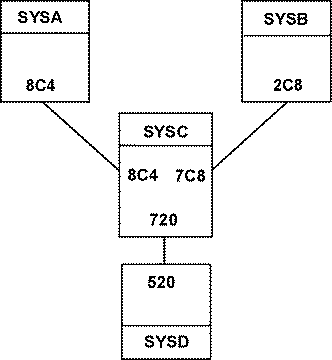
CTCPATH FROMSYSTEM=SYSA ADDRRSS=8C4 TOSYSTEM=SYSC
CTCPATH FROMSYSTEM=SYSC ADDRRSS=8C4 TOSYSTEM=SYSA
CTCPATH FROMSYSTEM=SYSB ADDRRSS=2C8 TOSYSTEM=SYSC
CTCPATH FROMSYSTEM=SYSC ADDRRSS=7C8 TOSYSTEM=SYSB
CTCPATH FROMSYSTEM=SYSD ADDRRSS=520 TOSYSTEM=SYSC
CTCPATH FROMSYSTEM=SYSC ADDRRSS=720 TOSYSTEM=SYSD
The preceding CTCPATH statements are placed in the MIMINIT member to represent this configuration.
Note: By omitting the TOSYSTEM operand, master eligibility is unable to be determined at initialization time. Without TOSYSTEM specified, CA MIM cannot determine connections. However, as the initial communication occurs, CA MIM reevaluates the master eligibility and notifies you of the changes.
Complete CTCPATH Statements:
CTCPATH FROMSYSTEM=SYSA ADDRESS=8C3 TOSYSTEM=SYSB
CTCPATH FROMSYSTEM=SYSB ADDRESS=2C3 TOSYSTEM=SYSA
CTCPATH FROMSYSTEM=SYSB ADDRESS=2C8 TOSYSTEM=SYSC
CTCPATH FROMSYSTEM=SYSC ADDRESS=7C8 TOSYSTEM=SYSB
CTCPATH FROMSYSTEM=SYSC ADDRESS=8C4 TOSYSTEM=SYSA
CTCPATH FROMSYSTEM=SYSA ADDRESS=8C4 TOSYSTEM=SYSC
Removing the TOSYSTEM operand reduces the CTCPATH statements:
CTCPATH FROMSYSTEM=SYSA ADDRESS=(8C3,8C4)
CTCPATH FROMSYSTEM=SYSB ADDRESS=(2C3,2C8)
CTCPATH FROMSYSTEM=SYSC ADDRESS=(7C8,8C4)
During the initialization, CA MIM initiates the communication on every locally defined CTC. For example, on SYSA CA MIM initiates communications on devices 8C3 and 8C4. As external systems respond to the communications on 8C3 and 8C4, CA MIM completes its internal representation of that path by filling in the destination systems name. As the connections are completed, CA MIM reevaluates the local systems master eligibility and notifies external systems if the local system becomes master eligible.
Note: CA MIM cannot synchronize until an eligible master is available. By removing the TOSYSTEM operand, CA MIM is unaware of eligible masters before initial communications complete. Therefore, CA MIM cannot synchronize and remains in a PENDING state. Issue the DISPLAY SYSTEMS command to identify any systems that are preventing CA MIM from starting. If NOPATH is specified, issue a FREE command to clear the NOPATH status and CA MIM then ignores that system during master eligibility evaluations. However, when doing a format start, CA MIM always honors the FREE status that is specified on the DEFSYS statements.
The master eligibility can change when you add connections. For example, assume SYSA, SYSB, SYSC, and SYSD are connected in the following fashion:
Dynamically adding paths from SYSA to SYSB and SYSD makes SYSA the master eligible connection.
Note: Dynamically adding a path on SYSA and SYSB creates a fully functional connection.
Virtual Control File Sizing Considerations
The VCF size is a mirror image of the primary backup DASD control file when the CA MIM complex executes in a mixed CTC and DASD environment.
The VCF image contains the same number of blocks (of size MIMINIT BLKSIZE), as the primary backup DASD control file. The primary backup DASD control file is defined as the DASD control file that was in use when the migration to the VCF took place. CA MIM supports up to 100 DASD control files. We recommend that alternate DASD control files be progressively larger in size than the primary control file. When the primary DASD control file or the VCF becomes full, a migration to a larger alternate DASD control file is successful. The larger alternate DASD control file yields an equally larger size VCF when compared to the original DASD control file size.
When running in a VCF-only environment (that is, MIMINIT COMMUNICATION=CTCONLY or MIMINIT COMMUNICATION=XCF), the VCF image size is dynamic.
VCF sizing:
|
Copyright © 2014 CA.
All rights reserved.
|
|