

CA Identity Manager reports enable you to see the current state of a CA Identity Manager environment. You can use this information to ensure compliance with internal business policies or external regulations.
You generate CA Identity Manager reports from management data which describes the relationship between objects in CA Identity Manager environment. Examples of management data include the following:
In CA Identity Manager, the reporting setup requires the following three major components:
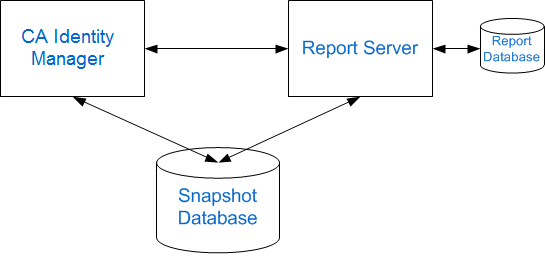
Note: The Snapshot Database in this illustration graphic could also be the Audit Database or Workflow Database.
Also known as CA Business Intelligence, this server generates reports, communicating directly with CA Identity Manager and the Snapshot Database.
The database where the CA Report Server (Business Objects) stores its own data.
CA Identity Manager allows you to export CA Identity Manager object data to the Report Database.
A separate database containing the snapshot data of objects in CA Identity Manager
Important! The Report Server uses Business Objects Enterprise. If you already have a Report Server in your environment and want to use it with CA Identity Manager, the minimum version required by CA Identity Manager is CA Business Intelligence 3.2 SP5.
A snapshot report include data from the Snapshot Database, which contains information from the CA Identity Manager object store and the user store. An example of a snapshot report is the User Profile report. You define the snapshot data that is added to the Snapshot Database and using snapshot definitions, specify the information to include.
The following graphic illustrates the process for running a snapshot report:
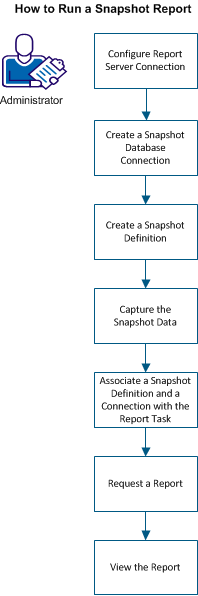
To run the snapshot report, perform the following steps:
|
Copyright © 2014 CA.
All rights reserved.
|
|